Eighteen and a half days after leaving La Paz, we arrived at Taiohae Bay, Nuku Hiva with the evening lights on the shore twinkling. We had sailed fast, avoided the ITCZ, arriving refreshed, excited and glowing from the celebratory bottle of Champagne after anchoring.
Nuku Hiva was discovered by an American explorer/trader called Ingraham in 1791. Taiohae Bay is the administrative capital of the Marquesas and is situated in a huge volcanic crater inside another crater with the caldera walls surrounding the town.
It was great to see Kevin from Nuku Hiva Yacht Services again and he swiftly aided our check in to the French Polynesian Islands. Stephen caused hilarity next door in Chez Henri (our WIFI hub and meeting place) by his desperation for a jus d’pamplemousse using defunct currency from our previous visit. Luckily they accepted dollars!
Over a few weeks we rediscovered our old haunts, ventured out on hikes around the town and up in to the hills. We ate at every establishment, some of which were exactly as they were before, Keikahanui Pearl Lodge hotel (expensive but wonderful), the Marketplace (our least favourite) and Moana Nui restaurant (fresh, wholesome, French cuisine). Rose’s place, Hee Tai Inn, had a new proprietor (La Patron) and the rich food, ambience and choice of wines had significantly improved. We especially liked his homemade digestive, Passionfruit Rum. On Saturday mornings the pretty yellow caravan opened his windows and sold authentic croissants, pain au chocolat and raisin. The “french bread” baked in town is woolly and nothing like the real thing, so our French caravan was a treasured find. The marketplace remained just as lovely with some of the older women adorned with their floral woven hats, selling fresh fruit, vegetables, banana candy (fermented banana wrapped in a banana leaf) and honey, always with a smile and a spattering of English. On this note, our French is improving and the women in particular are very gracious in their enthusiasm for our linguistic attempts.
Whilst we were in the bay, this year’s World Arc were in town. The VHF was buzzing with amusing conversations, some characters stood out and complicated organisation was discussed regarding meeting for dinner! This flooded us with memories of the banter we had on the VHF when we were on the OWR. The Aranui docked whilst we were there and has expanded into a bigger cruise liner with a cargo section for supplying the islands. The welcome from the islanders to the various cruise liners by singing and dancing is a great gesture but we realised how we were spoilt during the OWR. Our day of celebration was huge and made a massive impression on us. Our time before was limited so we used our present time to wander around the Paepae Vehine with its modern sculptures and Tikis carved by locals and Artisans from Easter Island. The Notre Dame des Iles Marquesas RC cathedral founded by Bishop Dordillon was stunning at Easter. Not only the colours but the perfume of the various flower garlands and arrangements in the church. The many traditional carvings were in contrast with the religious aspect of the church and it’s grounds. We saw this in many religious establishments throughout the islands.
Throughout the northern islands we met many international cruisers and had a few parties on board the good ship Amelie. Most people we met were friendly, fun, generous and some we made a stronger connection with. Manatee was such a boat, skippered by Chris and Irene with their two sons, Max and Bo, Luca the dog together with their young friends, Alfie, Jacob, Amanda and latterly Orly. Alfie hailed from Camden Town so he and Debbie talked a lot about London life and swapped ideas of drinking and eating establishments. Hopefully when we return to the UK in late summer we will catch up with Alfie and his family. The Red Flying Omelette, our previous tender and sailing dinghy found another home as the skipper of Revenant had lost his dinghy and motor the previous week.
There are mixed references to when the Marquesas were populated but it is suggested that between 200BC and 400AD the Great Polynesian migration happened. The history is sketchy as the Polynesians had no written language and the history was passed orally from generation to generation. This narrative was decimated when the population was reduced from maybe as many as a 100,000 to as few as 2,000 following interaction between the European explorers and traders. People from Taiwan and south east Asia in canoes found the islands using celestial navigation, reading cloud reflections and wave formations together with bird flight patterns. The canoes had two hulls fused by cross beams, carrying up to seventy people, plants, seeds and animals, either sailing, paddling or a combination of the two, to colonise the new lands. Over-colonisation of the Marquesas during this time caused many wars to break out between the clans. The society was feudal in nature, hierarchal with many rituals and customs. Human sacrifices were used in religious rituals and infanticide was practised, especially if a girl from a lower status became pregnant by an ari’i (Chief). More of the culture to come.
The first Europeans to visit the Southern Marquesas, were the Spanish in either 1567 or 1595. Alvaro Mendana de Neira discovered the islands, naming the islands after the Marchioness of Mendoza. Between 1774 and 1791, Captain Cook, Ingraham and Marchand found the Northern group. The “invasion” of the Europeans brought the same issues that we have referred to in previous blogs regarding the First Nation, Northern Territory people and the Haidas. Sex starved sailors, whalers and traders took advantage of the Polynesian uninhibited approach to sex. Sex was used to barter for nails (which the locals craved for making fishing hooks), clothes and alcohol. Prostitution became prevalent, spreading sexually transmitted disease which helped to cause the decline of the Polynesian culture. The Polynesians did not have natural immunity to the many European diseases, ie Smallpox and the population declined rapidly.

Stills were set up to produce alcohol, producing generations with alcohol related diseases. Clan conflicts were exploited by bounty mutineers, who acted as mercenaries with their weapons and ammunition, trading to the highest bidder. Opium was brought over by the Chinese plantation workers and the Polynesians became addicted quickly. The British and French battled over sovereignty of the islands with the French taking control by 1842, following a treaty between Admiral du Petit Thouras and the native chiefs. The plantations quickly failed because of drought, leaving many Chinese stranded and herds of cattle, sheep and pigs to roam the islands. The Marquesas do not have any indigenous land animals but many birds are found only on the islands, ie the Ground Dove.
Listless and exhausted the Polynesians with their “pagan” beliefs were soon impregnated by the Protestant and Catholic missionaries. They were encouraged to give up their belief system and ancient customs and many of the people embraced a new spiritual framework which helped them deal with the scourge of the new society issues, ie alcoholism and prostitution and it is claimed that this continues today with christianity being a strong backbone for the community.
The French enjoyed the wealth which came from the exports of vanilla, cotton, copra and pearls but this declined after WW2. The islanders speak French and Polynesian today with the schools following the French educational system.
Evidence of the ancient culture is everywhere. Discoveries of old sites are regularly found amongst the tangled vegetation. Some of the areas have been exposed and maintained to encourage tourism, others we stumbled across whilst on our many hikes. Tiki (carved humanlike sculptures) of various sizes are seen in gardens, along roadsides, hiking trails and cleared sites. Petroglyphs (rock art) are throughout the valleys and new discoveries are common. Ruins of paepae (traditional stone meeting platform), me’ae (sacred space) and tohua (arena for festivals, dances, fights and games) are a common sight throughout the northern islands. The me’ae were used for open air places of worship, for celebrations of birth, deaths and family events. It is supposed that the me’ae were situated close to Banyan trees so the deceased and their possessions could be placed inside the roots of the tree and eventually the root system would entomb them.
Cannibalism was common. Generally “Long Pig” was a victim of clan conflict, a sacred offering to the Gods, famine (feasting from their own clan) or vengeance (laying ambushes for a nearby clansman). Women and lower status individuals did not eat man meat and the eyes were a speciality, saved for the chiefs and priests. Europeans not only abhorred this practise but feared it too. The European missionaries strived to “humanise” the Marquesan people by converting them to Christianity and forbade eating human flesh, together with tattooing, “pagan” wood and stone carvings, banning the music and drumming (Devil’s music) and tightly controlled the “lewd” dancing of the men and women. Consequently a lot of the Polynesian culture and history was lost due to this arrogance. It wasn’t until 1956 that traditional dancing was brought back. Once again, we witnessed the Haka Manu, “Dance of the Pig” and the sensual female dancing together with Polynesian music using drums, ukuleles and plastic bottles filled with rice! Marquesan tattoos based on old paintings and drawings are now adorning many Polynesian bodies, often describing their life and family history. Tattooists are happy to tattoo Europeans using their individual style and symbolism. Master carvers are selling their wares to tourists that visit their villages and in Artisan centres. The beating of bark to make cloth is still practised (tapa) and artists paint creatures with plant dye.
Reports written by the first Europeans describe Polynesian family life and it is similar today. Families live close or with one another, they spend their free time together and although it appears to be a male dominated community, the older women are revered. Mahu are males who are raised as girls and live their lives as women. They are accepted in the community, have families and act like effeminate men. Raerae are flamboyant transvestites, of whom some are prostitutes. There was a great deal of confusion amongst a few boaters who would insist in calling all effeminate men, Raeraes! We were careful not to offend individuals. Raeraes are often found in Pape’ete’s nightspots.
One delightful aspect of these islands is that many of them and their villages have retained their Polynesian titles. The people have a French and a Polynesian name but with us they generally refer to their French name. This is helpful since our tongues struggle with much of the Marquesan dialect.
West of Taiohae Bay is Hakaui Valley, Daniel’s Bay with the Vaipo waterfall. We anchored in Hakatea Bay, amongst a canyon with 800 metre walls, walking along the shoreline, amongst the woods and through a fast running river to Patrick (one of Daniel’s 18 children) and Kua’s homes in Hakaui Valley. This valley was once owned by King Te Moana and Queen Vaekehu, with an ancient royal road running alongside the river past many ancient sites overgrown by vegetation. We hiked up to the waterfall which is the highest in the French Polynesian Islands at 350 metres and enjoyed the cool waters of the natural pools with a “painted cave” and a trickle of a cascade. Along the way we found many ua mas (breadfruit storage pits) and Tikis poking out of the vegetation. Arriving back at Kua’s we enjoyed a traditional meal of wild pig with salad and fried breadfruit. Stephen enjoyed the fresh mango juice. Here we were able to buy a variety of fruit to replenish our supplies.

After a swift visit back to Taiohae Bay, we motored/sailed to Anaho Bay on the north eastern side of Nuku Hiva. Many who have visited here will be amazed that we didn’t go to Taipai where Herman Melville spent some time and wrote a book “Typee” about his adventures…….we are saving that. We sailed through a dense school of over a hundred Melon-headed Whales, which are also known as Electra Dolphin. They are beak-less, blunt headed, gregarious and demonstrative. They displayed classic traits by swimming just below the surface, making shallow leaps and then charging around the boat to repeat their performance. They stayed with us until we turned into the bay. Anaho Bay is beautifully sheltered and calm with a small community along the shoreline. It is claimed as the only coral reef on Nuku Hiva and it was noticeable at low tide. Robert Louis Stephenson (RLS) was here in 1888, describing the bay in his book “In the South Seas”. Little has changed since then. We enjoyed the surf on the eastern side of the bay, Debbie attempting to body board but the undertow was exceptionally strong, dunking her often with sand getting into every crevice. Luca bravely rode the surf and later found a small Black-tipped Reef Shark to chase. Most mornings singing was heard coming from the small chapel along the shore, drifting over the air to our boats languishing in the bay. Irene and Debbie hiked a short distance eastward to the farm to find no one at home. A knife stuck out of the prep table and armed with this, fruit and vegetables were collected and weighed on the antiquated set of scales with our money left under the ghetto blaster. The farmer had set up an intricate irrigation system, which the enormous wasps (whose sting kicks a punch) supped from. It was a joy to choose our produce and know that it was very fresh.
Here we embarked on a challenging one and a half hour hike along a pony trail to Hatiheu, where we found a picturesque village with a bustling community. We “gate crashed” the Aranui’s display of dancing and singing in Chez Yvonne and enjoyed Wild Pig cooked in rum. We went back again as it was so good! This restaurant is an open air thatched dwelling looking out to sea. A narrow stream flows alongside and we witnessed one of the ladies throwing bread into the stream. Immediately huge eels appeared engulfing the bread, they barely had any water to swim in, as they were so enormous. Opposite, 300 metres up a mountain a white statue of the Virgin Mary, erected in 1872, overlooks the bay. Orly took us to Hikokua archeological sites (1250AD) late in the afternoon. With the sun low in the sky it cast an eerie, mystical light over the ruins and you could almost imagine fierce warriors and angelic ladies performing in the arena. RLS describes the sites and statue in his book.
We paid a second visit to Anaho Bay with Curtis and Julie from “Manna”, introducing them to the beauty of this place and of course, any excuse to go back to Chez Yvonne where this time we dined on Spiny Lobster which appeared on the menu. On our return from Hatiheu we met several men on ponies transporting Copra, the sounds of Marquesan Reggae blasted through the hills from a ghetto blaster on the lap of a chilled Rasta, who gently nodded as he passed.
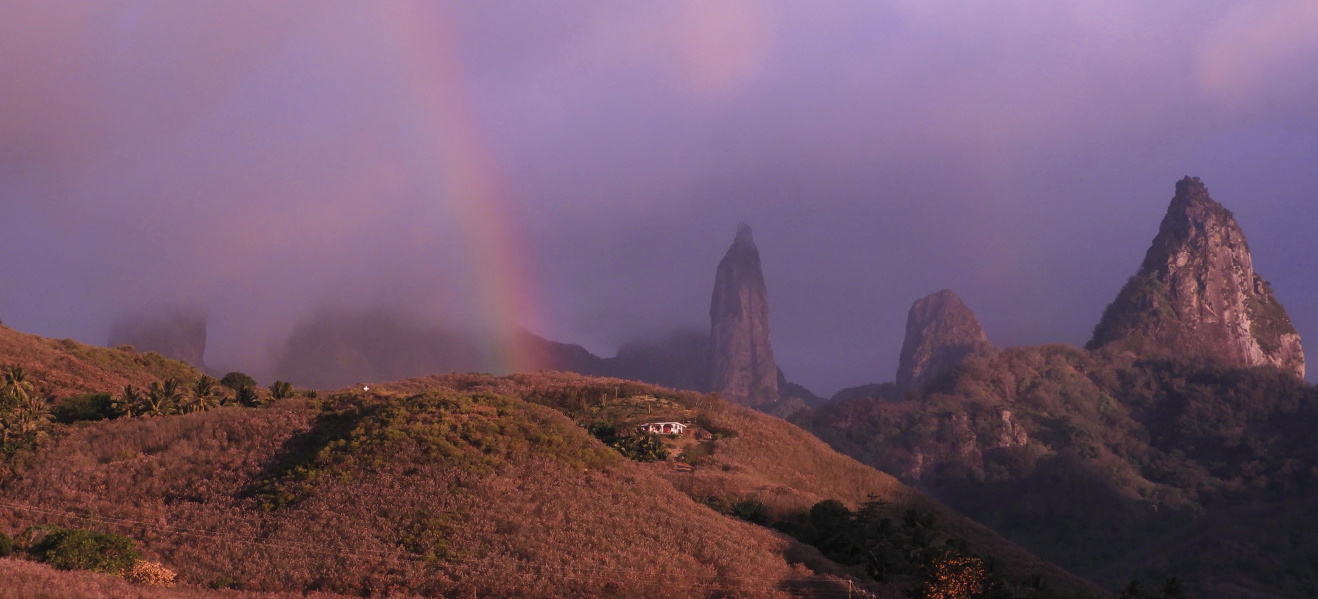
Following a rolly night we set off for Ua Pou (pronounced ooar po and not waahpo as in the guides), an island south of Nuku Hiva with the characteristic spires jutting into the sky, often shrouded in cloud. These pinnacles also known as Phonolite are viscous lava protrusions which are hardy to erosion.The island is famous for “pierres fleuries” (flowering stones) which are pieces of crystallised Phonolite, producing amber flower shapes. Ua Pou has the tallest, most vertical mountain in the Marquesas, Mount Oave at 1,200 metres. The island was discovered by a Frenchman, Marchand in 1791 and was a haven for missionaries when they were physically evicted from Nuku Hiva.
After an aborted attempt to anchor in the island’s administrative capital, Hakahau, we motored around to a much calmer anchorage, Hakahetau, on the NW coast. We passed Aneou Bay where a short, steep airport runway is situated in a valley. Daily flights from Nuku Hiva serve as an inter-island connection.

Hakahetau has a huge cement wharf built in 2017 we believe for the successful art and music festival. The water was clear and snorkelling overthe coral reef was fantastic. The sleepy village is neat and tidy with clucking hens and the odd goat passing by. A main concrete road ascends through the village tapering into a 4WD track through lush vegetation until we came across a natural fork. The right fork led to a stony pathway at times laid with boulder steps leading to a tiny waterfall with a cool, fresh pool. After our hot, sweaty and dusty hike with Jacob as our guide, this dip was sheer heaven. The left fork continued as a 4WD track for 1,500 metres until we reached the “Chocko-Mann’s” residence. Manfred, originally from East Germany and his Marquesan partner, Therese have a remote, secluded holding producing homemade chocolate from their Cacao plants, coffee, tobacco and generally self-sufficient. Twenty-three cats all well fed and loved, kept the rats at bay. Roosters, Chickens and Chicks strutted around the stony terrace, pecking at insects inside coconut husks together with being fed freshly baked bread and a scattering of rice. We announced our arrival by clanging a spanner against an old wok (Manfred’s idea of a door bell) and immediately the sound of aggressive barking was heard. From around the corner came two fat, noisy guard dogs, who appeared to be more cautious of us than us of them.

Manfred and Therese welcomed us into their spotless, open air kitchen, helped by the fact that they had met Jacob a few days previously. He was welcomed like a lost son returning to the homestead, feeding him with baked bread and their chocolatesauce. Quickly we were sampling his chocolate and after buying some supplies, Manfred kindly gave Stephen a tour of his tobacco plants. SBW is now curing his own tobacco for firing up his pipe. The washing line and pegs are now nicotine stained.
Stephen’s beer supplies reduce rapidly in these bays, mainly through entertaining and by goodness, the local men can drink! The only shop in the village were unable to replenish our dwindling supply as they only sold beer at weekends.
We continued on our journey and we successfully re anchored with bow and stern anchors in the claustrophobic Bay of Hakahau. Kevin had advised us to visit the Gendarme on each island as a matter of courtesy and afterwards we explored the amenities of this coastal town. We were pleased to find a busy bakery, selling better tasting bread, although Therese’s homemade bread is the best so far. Further along was an Artisan centre with lots of handmade goodies to buy, next door was a co-operative centre who were famous for their cheap, local buffet and selling chutneys, jams and fresh produce at extremely good prices. Debbie became reacquainted with Aunty Chloe and “his” niece, who we had met the night before, who were involved in this co-operative. The four supermarkets were better stocked than those on Nuku Hiva with masses of choice, also their stock taking appeared to be sensible. However the prices were higher than Nuku Hiva, particularly alcohol. We tried out various eating establishments which were wonderful. The family run pizza cafe with Bollywood films on the TV was great. The romantic setting of Restaurant Pukué é was a delight with the owners, Jerome and Elisa, slightly reserved but serving fabulous wines and “cordon bleu” meals. Chris and Stephen returned to have their hair cut by Elisa who is multi talented. WIFI has been and continues to be hit and miss in these islands and with the boat computer not functioning we were reliant on our local ‘phone and the satellite telephone.
Orly had delivered his supply of Copra to the Aranui and paid for his passage from Nuku Hiva to Ua Pou to meet up with Manatee again. He hadn’t been back to the island for ten years and he was keen to introduce us to his friends. Meanwhile he entertained us with his story, the history of his beautiful tattoos and helped us understand a little of the present day culture.
Together the two boats anchored in Baie Hakaotu where Orly’s friends had a weekend home. The anchorage is snug with “Pain de Sucre” headland at the entrance. Debbie enjoyed using her SUP in the bay although her balance was pretty poor, something to do with the Rosé at lunchtime? This certainly entertained the local children and before long three kids were joining Debbie on the board. Luca was enjoying the freedom and safety of the water and shore including a stand off with the biggest pig. Everyone was laughing with Muriel the grandmother and her daughter-in-law holding court on the stony beach. Friendliness exuded from every pore even with limited language, an instant rapport was discovered. The men of the village were nowhere to be seen.
The following day we were invited to go ashore for their traditional Sunday gathering. Two pigs were roasting over a fire pit, straddled to wooden beams, the skin becoming crispy. Huge bowls of vegetable rice, Chicken rice, marinaded octopus, Poisson Cru and Stephen’s favourite, roasted Trigger fish, which he devoured. We were given large, washed leaves as plates (far better than paper plates) and apart from the odd serving spoon and fork, we used our fingers to serve and eat. We were treated like royalty and the presents that we gave were graciously accepted. Meanwhile the beer, homemade hooch, vodka beer mixes, wine and rum flowed freely. The men, mostly the younger ones, were very drunk and after a while we observed that they were slightly scornful of us, becoming rowdy and possibly not very kind. The women continued to be lovely and very keen for us to stay or re visit. This homely, sparse dwelling with an outside privy (Muriel kept guard over the beer cooler and the toilet roll) and massive boulders as chairs, this was the focal point for their friends and other family members. One guy brought his pet goat to the party, pigs of various sizes were rummaging in bags and snaffling any left over food, chickens were free range, the main hunting dogs were tethered and fed at the same time as the people. A cute puppy enjoyed the attention from adoring Europeans, mainly Amanda who fell in love with her but the best was a month old orphaned piglet that squealed, snorted and scurried around, thinking that Muriel was its Mum and loved SBW’s beer. Muriel assures us that this piglet will be her pet and not for the feast. The following day whilst eating breakfast, Muriel’s husband and eldest son in their pirogue rowed to Amelie with a sack of fruit and a branch of bananas. They refused coffee but consumed three cans of beer each, all before 9am. The kindness of the island people is immense and warming.
We were looking forward to meeting up with Curtis and Julie (friends that we met in San Diego) in Ua Huka later in the week, so we waved “Adieu” to Manatee and chilled in Baie de Vaiehou on the west coast for a few days. We were guided into the bay by a school of striped dolphins, slowing to our speed whilst a larger group near by were calmly fishing. The guides suggest that this area is uninhabited but smoke was rising from two thatched huts on the elevated shore. 4WD trucks were parked near by and families were frolicking in the surf or beach-combing. The snorkelling and kayaking was the best so far with a huge diversity of fish in crystal clear water. One type of coral appeared to be healthy and abundant with the shoreline topography blowing our minds. Sea caves, blow holes, plateaus, crevices, small lava spires and hundreds of sea birds swooping around the bay, made this a very special place.
A note before leaving Ua Pou, most of the names here start with Haka and we asked Orly for the definition. We believe that he probably misunderstood but we learned that Haka is a dance or an enormous red fish that we shouldn’t eat as we would die! We will get to the bottom of this conundrum.
We motor sailed to Ua Huka, an island which is rarely visited as it is off the beaten track. The island has three villages and we chose Hane Bay to anchor. As the light diminished the soccer field was strewn with young lads, training and then playing a game until darkness. Pick ups loaded the boys and transported them to their abodes. The people were extremely friendly and kind, always happy to chat and gave us lifts over the steep passes, opening the marine and petroglyph museums especially for us. The coastal road constantly had a flow of 4WDs, horses and the many mountain goats on the island. The island is also famous for the locals skimming up ropes on the outlying vertical islets to collect Sooty Tern eggs to make the local delicacy, red, fishy omelettes. It is safe to say we did not go there!
The highlight of our visit to this friendly island was to meet up with Curtis and Julie and as an added bonus we caught up with Sheila and David from Shoreleave. We celebrated together, sharing food and wine on Amelie.
We attended a beautiful Sunday service in the R.C. church which was held in the Polynesian tongue, the singing was heavenly without any musical accompaniment with the locals dressed in their finery. Holy Communion was administered to the congregation plus a lady who sat outside the open church doors in her car was included. A very moving experience.
It was time to fuel up in Taihoe Bay, Nuku Hiva which Debbie was dreading but it went very smoothly and the tank was filled to the brim…..the Tuamotus were calling!
