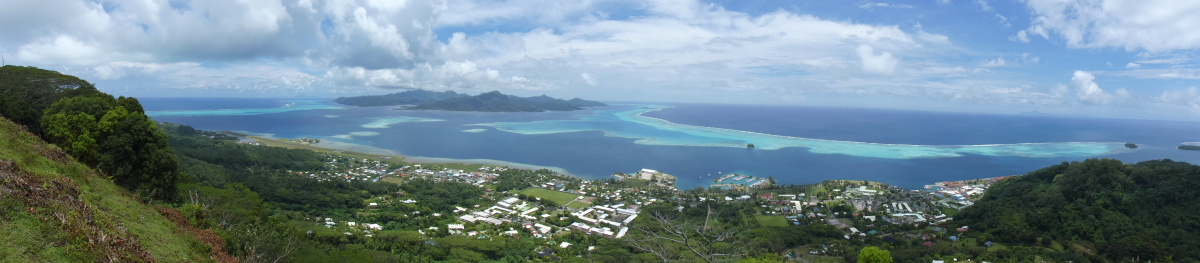
Raiatea did not leave great memories from our rally days but many of our friends in Moorea gave us glowing reports and we decided to visit with an open mind, albeit we planned to stay only to buy fresh produce. Lo and behold we’ve fallen in love with the place helped by it’s beauty and spending some time with Doug and Maureen from Sophrosyne. We had just missed Maluhia on Huahine but hoping to catch up with them at a later stage.
After so much wind the previous weeks, we had a breath as we motor sailed across the 22 miles to Raiatea. At least the water was burning hot for washing up, having run the engine.
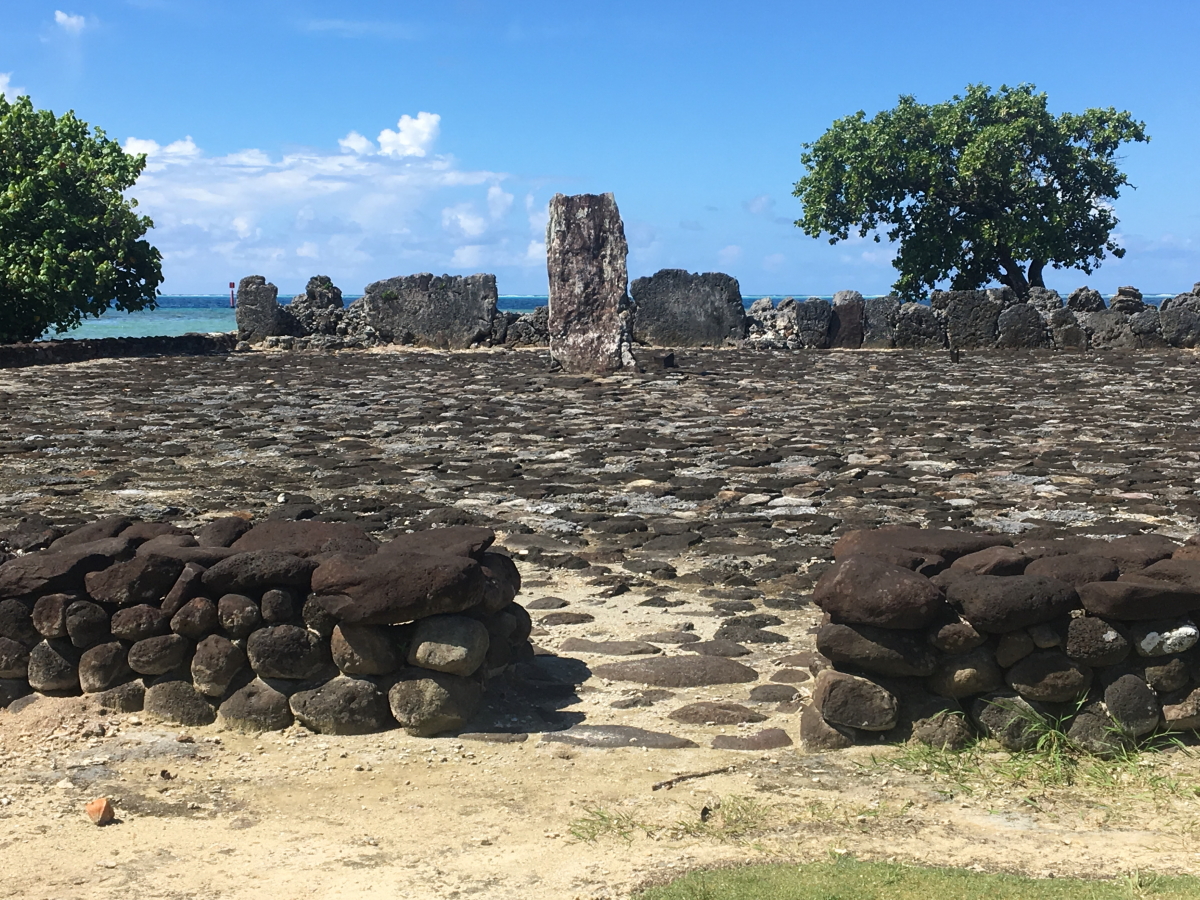
Raiatea, with Uturoa as it’s administrative centre, was originally called Havai’i Nui meaning “Big Springing Water”. However, Raiatea means “faraway heaven” or “sky with soft light”. It is considered the sacred centre of ancient Polynesia with the huge Taputapuatea marae at Opoa being “god’s cradle” throughout the Polynesian triangle. It is dedicated to Oro, the god of war, who dominated the Polynesian’s belief system until the missionaries arrived. On reading, it is suggested that for any other marae to be built on other islands, they had to obtain a Taputapuatea stone to include in it’s construction. People on canoes from as far away as Hawaii and Aotearoa (New Zealand) travelled to this temple to pay their respects. The vast area overlooking the lagoon is now a designated UNESCO site. Raiatea’s symbol is the rare tiare ‘apetahi, a flower that is found on Mount Temehani. This delicate flower only blooms at dawn and it is forbidden to pick it. This island also has the only navigable river, Faaroa in French Polynesia.
Cook visited the island several times and anchored off Opoa, before leaving for his fateful voyage to Hawaii. At the end of the eighteenth century there was unrest in the island with fighting and eventual conquering of Raiatea and Taha’a by the fearsome warriors from Bora Bora. The following thirty years consisted of a power struggle between these Chiefs to get overall control of Raiatea and her sister island, Taha’a. Eventually the Pomare royal family (from Raiatea) took control, encouraging christianity and developing a code of obedience from their people towards the missionaries, from 1818 onwards. Similar battles already described in the Huahine blog, with the French, carried on until 1847 when the French recognised the islands independence. These skirmishes continued until Raiatea and Taha’a surrendered some forty years later, in 1897, battle worn and ravaged.

The Pomare royal family and it’s descendants are important in the Society Islands history as they spread themselves throughout the Societies, converted to Christianity and ultimately encouraged the islanders to follow suit. The ancient beliefs and relics continued alongside their new beliefs despite the missionaries interfering by building churches on sacred maraes, and attempting to deny the Polynesians pagan practices of tattooing, dancing, music, offerings etc. Consequently we are enjoying aspects of their ancient culture during our travels. One Pomarian, Tamatoa IV was an absolute brute who ruled over Raiatea and Taha’a from 1860-1871. He was a drunk and displayed unpredictable violent behaviour. He was a dangerous individual after drinking to excess causing him to be banished from Tahiti. His human atrocities were so horrendous that eventually his subjects refused to put up with his ruling and had him dethroned.
Today, tourism is a big part of the island’s economy, together with agriculture and fishing. The fresh produce market in Uturoa is a gem with the confident ladies selling their produce often giving away extra bananas. The shops are laden with gifts, beautiful clothes, hardware, together with health and beauty facilities. The town of Uturoa has certainly had a facelift since we were here six years ago and there is a certain “zing” in this bustling town. Uturoa means “long mouth” and suggests that the locals like to gossip. It isn’t unusual to see the ladies in the market in one corner, keeping an eye on their stall, whilst catching up with the news with their fellow stall holders. As we are “foodies” and enjoy the finer aspects of this pleasure, the Champion supermarket is superb, clean and the choice is the best so far. Raiatea has become the nautical base of the area with Moorings, Sunsail, Dream Yachts and Tahiti Sail yachts frequently being seen in the many anchorages and a few marinas.
Together with Maureen and Doug we hired a car and circumnavigated the island, naturally stopping at the Taputapuatea marae. This magnificent marae was constructed by the Polynesians lighting fires at low tide, on the coral reef. The heat caused splits in the reef and allowing them to extract blocks of coral to build this structure. The marae is built opposite the Teavamoa pass, to assist visiting canoes, with their occupants to attend the grand ceremonies. We imagine it wasn’t just a convenient site to build a marae, there must have been more spiritual, sacred and historical significance to the construction and location. Human sacrificial ceremonies were held to appease the God of War, Oro, with the skulls of warriors imbedded in the cavities. The marae was cloaked in sacred secrecy and today, there is a huge gap in the history of this vast temple. It dates back to the seventeenth century and has been well preserved. Inaugural ceremonies, political alliances and international meetings would take place here in ancient times. The site was “taboo”, a common word we have come across, that is seen on many signs signifying private and was considered the headquarters of the religious and political powers of the Polynesian region. Today the communities of Hawaii, New Zealand and Cook Islands still meet at this pilgrimage site, which they consider the home of their sacred culture.
The following day was the Skipper’s birthday and like most years, Stephen stipulated what he wanted and organised his day. Debbie was the commis chef, producing courses of his choice. Maureen and Doug joined us for a day of fun, food, a little exercise and introducing them to Mexican Train…..yes, we got them hooked. The icing on the cake was the flurry of ‘phone calls to and from the UK, especially the grandchildren, Charlotte, Elizabeth and Fraser, who is growing like a weed……something to do with his voracious appetite!
As mentioned before, there are always jobs to do on the boat and we interspersed them with snorkelling, swimming and reading. One of the many highlights of this beautiful island was a hike into Raiatea’s mountainous interior. The view back towards Uturoa is dominated by Mt. Tapioi and with it’s well maintained trail we ascended to 294 metres to overlook the lagoon and four islands…..Bora Bora, Taha’a, Huahine and of course the one we were perched on, Raiatea. The views of the reef, passes and the coral heads was spectacular, the guide book was right. The lower part of the trail was the grazing ground for cattle and horses with their foals. Unperturbed by humans, they merrily munched away at the grass, while chickens and their chicks scurried up the dirt banks. The hike took about two hours, it is a moderate climb, shady places along the way and we felt as if we done some exercise, so celebrated with a nice lunch in town.
Daily weather updates suggested that we were expecting a NW gale so the decision was made to move to a cyclone hole on Taha’a, Haamene Bay. The Hibiscus Foundation is located in the bay where they shelter, feed, nurse and return sea turtles to the ocean. We remembered Tony and his crew of Wolfhound, releasing “Wolfie” an adopted turtle, six years ago on the rally. The long transit into this bay was beautiful surrounded by towering mountains, unfortunately the township of Haamene was unattractive. Ugly, empty, grey buildings clogged the mouth of the bay and in contrast, there was a modern public pontoon with men working on refurbishing the church, next to the ornate government building. After experiencing blue, clear water we were now surrounded by murky, brown, coconut strewn water. The locals were very friendly and helped identify a fruit that we had bought, Apiu or Yellow Star Apple, originating from the Amazon. Delicious, fragrant, soft pear like fruit which enhanced the fruit salad bowl. We were thankful for the clay/mud seabed and our amazing anchor, as before dawn we were subjected to violent surges of wind and rain ripping through the anchorage. The noise of the torrential rain hammering through the trees gives you short notice to batten down the hatches and steam in the unventilated heat of the boat. A flurry of messages and calls to and from our friends in Huahine and Moorea, enabled us to know that everyone was okay.
Opposite Haamene Bay just off Motu Toahotu, in calmer times, we had some of the best snorkelling on our travels. The drift snorkel through the Toahotu Pass was as good as Cocos Keeling. Gently drifting over underwater canyons, discovering new species of fish for us, the odd small Black Tipped Reef shark, the water teeming with millions of fish, not bothered by us and to top it off, a fever of Eagle/Bat Rays dancing through the depths. It felt like we were getting a private performance. The other side of the pass has a back eddy but the coral is stunning and the odd Moray Eel reared it’s head from it’s protective hole. Naturally we revisited this site a few times, still enchanted by the beauty and abundance of life.
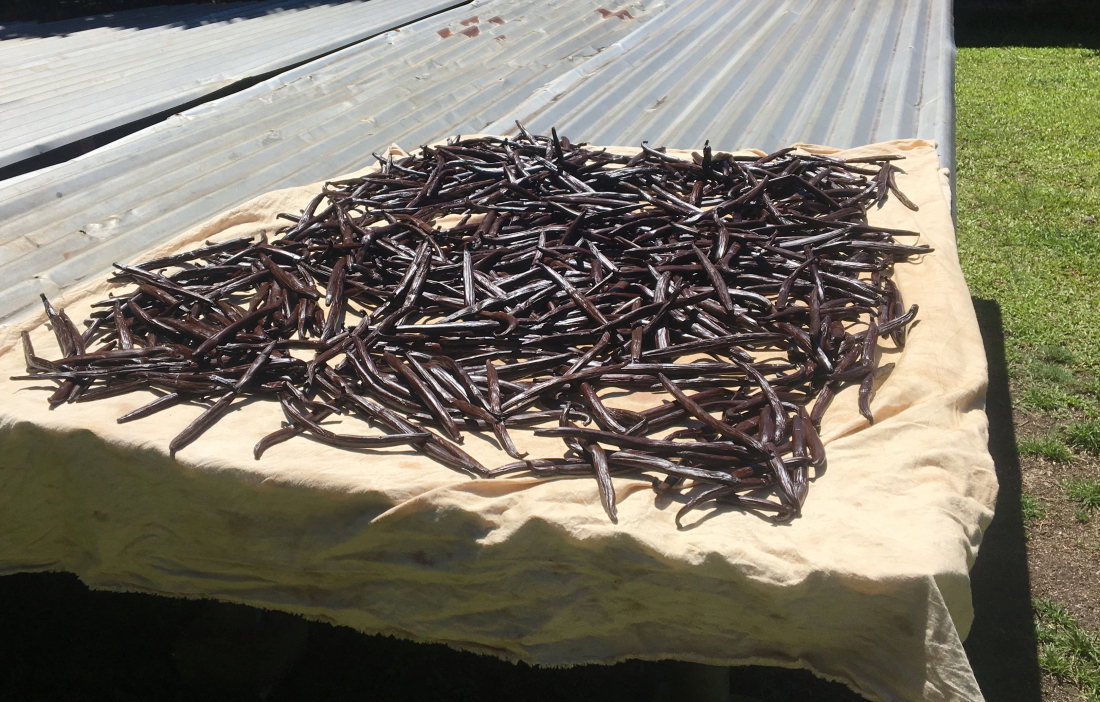
Taha’a and Raiatea rise from the same seamount and share the same barrier reef. Taha’a’s ancient name was Uporu and the island is the shape of a four leaf clover. Today the island, surrounded by sandy motus, is known as the “Vanilla Island” because of the pervasive aroma and it produces 70%-80% of French Polynesia’s vanilla production and it’s emblem is the vanilla flower and bean. It’s inhabitants mainly descend from the authentic Maori race. Taha’a and the motus can only be reached by boat, water taxi or pirogues from Raiatea.
Vanilla exports help this small island’s economy but is labour intensive. Kim, David and the Amelies decided to visit a small plantation, Vallee de la Vanille, a short dinghy ride away, close to Faaha Bay. As soon as we walked down the dusty drive it felt that we had been transported into another time zone. We were greeted with fresh mango juice and encouraged to sample freshly cooked Uru (breadfruit) chips and slices of coconut, threading our way through their open air produce shop. The vanilla products ranged from pods, extract, pate, lotions, oils, flavoured coffee additionally they sold handmade garments. A delightful man gave us an informative talk about his family’s vanilla farm, swapping from French to English. We were pleased to understand more French than we had realised. The small audience involved hotel chefs from Bora Bora, lots of culinary knowledge.
The family use vanilla cuttings and grow them at the base of various non fruit bearing trees, i.e. Wild Fig, for support of the non parasitic vanilla vine. The plant has a healthy productive life of approximately ten years and because it is sunny all year around, the Taha’a vanilla is the sweetest. It can take up to five years for the vine to mature and flowers during the third year. Coconut scraps are distributed around the base of the tree for compost and moisture for the growing plant. The workers allow the vine to grow to a height of up to 1.8 metres, before pruning. Fertilisation is done by hand, unlike in Mexico where the Hummingbirds and Melipena bee do the pollinating. The expert workers use a fine stick (similar to a thin kebab skewer) to collect the pollen from the stamen of the male flower and gently place it on the female stigma. This ingenious idea was discovered in 1841 by a Reunion slave, Edmund Albius. Pollination must happen within 8-12 hours of the flower opening and as the flowers open only once, the process is vital and timely. A pod will grow 6-10 inches in six weeks, a healthy vine producing 100 pods per year. Each fertilised flower makes one vanilla pod which ripens over time. Unfortunately for these hard working people, the many birds love vanilla pods as a snack, therefore they have to be vigilant.
Between April and late August, the beans are collected by hand and placed on a cotton cloth in the sun for a few hours each day, turning from a motley green to the characteristic dark brown, aromatic vanilla pod. The pods are “sweated” in a simple wooden box in between sunbathing and the female members of the family turn, massage and select the pods when ripened. Yes you did hear correctly, the ladies massage the pods to straighten them! Deformed or broken beans are chopped and ground into vanilla powder. The vanilla extract comes from deformed beans stored in alcohol. The characteristic aroma of the vanilla is from the seeds and the oily substance around them. Stephen has got his own extract ageing as we write. Cooking tips from the chefs gave us some more culinary ideas and the avoidance of over flavouring cooking, i.e. tips for Debbie’s homemade ice cream.
Going back to the production of the vanilla….. there are only two farms on Taha’a (Faaha Bay and near Apu in the south) and in 2017, our farm produced 3,600kgs of vanilla. The Taha’a vanilla is called Tahitian Vanilla Aromatica, winning a Gold Medal a few years ago. This plant is a combination of four different types of vanilla from Mexico, Martinique, Guatemala and of the Bourbon vanilla from the Indian Ocean, predominantly Madagascar. Madagascar produces 85-90% of the world’s production. The prices soared after the Cyclone Enawo devastated 30% of the Madagascar crops in 2017. Vanilla is the second most expensive spice after Saffron.
After additions to the food cupboards and soothing after sun lotion purchases, we hastened back to Amelie to welcome Sophrosyne back in the “hood”. Later we were to revisit with Shorleave.

With settled weather, clear skies and shimmering heat we motored up the east coast of Taha’a, passing the mountainous main island and it’s surrounding palm tree sandy motus, many of them privately owned and one or two with attractive small hotels. The “capital” Patio is nestled at the base of the elderly extinct volcanos, with it’s pleasant town and friendly people. Rounding the northern tip we saw for the first time in six years, the beautiful Lagoon Tau Tau with it’s coral garden and the sandy bank full of Eagle and Tahitian Rays. Wonderful memories flooded back from our previous visit with the rally, enjoying decadent meals at Le Taha’a resort with Babe, Spent, Legend and Crazy Daisy; spending time with Mariella and Dreams Come True, together with Jaz who had the most memorable holiday. This time we paced ourselves and had an equally great time with entertaining on one another’s boats, visiting a two well established, family run pearl farms, drift snorkelling the coral garden at an alarming rate, kayaking and observing the largest Tahitian Stingray we ever encountered. Several trips to the mainland village of Tapuamu, one of which was to meet the supply boat from Tahiti for Stephen to collect his much needed supply of cigars! Eventually we had the lagoon to ourselves for almost 24 hours and enjoyed the magnificent sunset highlighting the magical design of Le Taha’a, twinkling pontoon lights dancing in the wavelets lapping the wooden structure and the quietness of the bay.
The weather in the rainy season appears to be unpredictable, so two weeks of fantastic weather gives way to sultry hot overcast skies with a deluge of rain at inappropriate times, nevertheless we made the most of it, mainly sorting out our iTunes pickle with the help of Liam and Clive, swimming in the rain and using the hours to do inside chores. During a dry spell on a sleepy Sunday we decided to stretch our legs, get off the boat and walk all around Uturoa. The place resembled a ghost town with everything battened down including the two fuel stations. The port was empty and we ambled along the wharf while drummers in a shelter were playing short busts of their practice. The town was peaceful but unlike the bustling Uturoa we know.
The following day we took Jaye and Irwin’s advice and anchored further down the coast, nestled in a crescent shaped area by Ile Tipaemau, just off the Passé Iriru. Negotiating the tiny pearl farm and it’s buoys we eventually chose a spot, a deep anchorage with a sandy bottom. We had this anchorage to ourselves, with the various seabirds and waders singing to one another; the roosters and chickens ashore letting us know that the island was their home; the baby breath of breeze rustling the palm fronds and firs; the odd thud as a coconut thundered to the ground and the lapping of the water against the sandy shoreline. We regularly say that this is paradise and the views are breathtaking but this place is out of this world. We were protected by the reef fringing the lagoon with crashing waves against the coral barrier and opposite the shapes of steep mountains, which change appearance with the light, as a backdrop to Faaroa Bay.
With great excitement we welcomed Dave and Sheila on Shorleave with their guests, Mike and Sue into the bay. Over the next twelve days we had some form of a party everyday, lots of laughter, various board games and naturally the clinking of bottles and great food. Shorleave looked spectacular at anchor with a stern tie to a tree ashore. From here we paid another visit to the Marae Taputapuatea on a sleepy Sunday, sharing this site with a few other people and the security guards having a siesta amongst the huge root system of a tree. The various maraes on this site have their own identity, some close to the waters edge, others adorned with shells and necklaces, weather worn and polished stones providing floors, platforms, sacrificial areas and resting stones for the Chiefs and priests. The site is clustered with various trees, shrubs, bushes and flowers. Different bird songs float across this spiritual site and an overwhelming sense of peace is palpable.

After a few days visiting various anchorages off Taha’a we enjoyed an exceptional supper at La Pirogue Api. We were welcomed by Cecile under the glow of lamps on the pontoon, led via a sandy path to a stairway into a comfortable bar with beautiful decor. We knew from Maluhia that the evening meal is a piece of art together with eating what the chef, Franck, decides to create that night. As none of us were fussy we thoroughly enjoyed the exquisite cordon bleu meal, entertained by the circling sharks beneath the dining hut waiting for scraps. Cecile encouraged us to return the following day to snorkel off this private island in the shallow coral garden. The current was very strong but worth the work out to see the glut of fish and beautiful coral. A truly romantic experience on this piece of extravagant real estate, as beautiful during the day as it is at night with great company.
Bora Bora called to us and hoping for a sail, we got the boat seaworthy and set off into a glassy sea with a slight swell. Raiatea and Taha’a still visible we realised that it maybe a long time before we return. Sometimes it is hard to return to places that you've had fond memories of. The expectations and sometimes the disappointments can be huge but we added wonderful memories to those of the Oyster World Rally, leaving a warm glow of fondness for these sister islands and the friends that helped us have such a fun time.