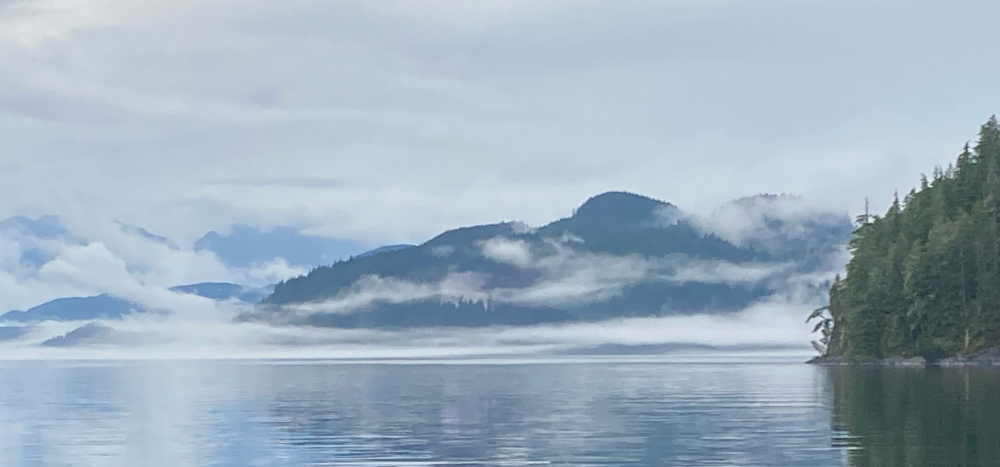
The feeling of freedom when we up-anchored at some unhealthy time in the morning was huge. Apart from some heavy seas going across the Juan de Fuca Strait, we enjoyed a comfortable sail towards Bedwell Harbour to check into Canada. Later that afternoon we continued to Ganges on Saltspring Island for fresh provisioning and cigars. 63nm in ten hours was good going.
The anchorage had exploded over the last year with derelict looking inhabited vessels. One boat was partially submerged, only kept afloat by mooring lines to a wooden pontoon and a huge plastic bag full of air, under the bow. Signs of human habitation were noticeable on board! Thank goodness for the luxury of Amelie.
We were keen to travel distances everyday in order to meet up with our good friends, Dave and Sheila, on their new motor vessel “Far North” and what a beauty she is. There was so much excitement in seeing them again. We hung out together in idyllic anchorages, hiking, lake swimming, barbecues, crabbing, trapping prawns and salmon fishing. Sheila and Debbie have a very similar sense of humour and the laughter was non stop with the husbands’ eyebrows raising every now and again. The weather was magnificent with high temperatures, some smoky haze from the wildfires but days of never ending warmth and blue skies. Summer had definitely arrived.
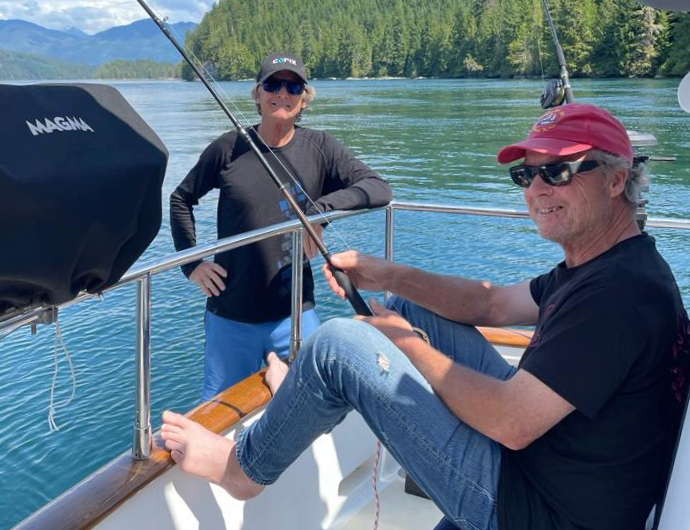 Fishing with Dave
Salmon fishing was hopeless last year but the Skipper is determined to fill the freezer for the winter. One of our fishing excursions was highlighted by a Humpback whale gently breaching amongst the fishing fleet. The wildlife around here continues to astound us.
Eating good food is always a pleasure, further enhanced by sharing the experience with good friends. The four of us decided a treat was in order and we had a great meal at “The Laughing Oyster”, one of our favourite haunts in this area. Dave caught a good sized Spring Salmon off Cape Mudge, which we devoured over a couple of days, taking it in turns to cook. We had further success with crabbing and rockfish catching.
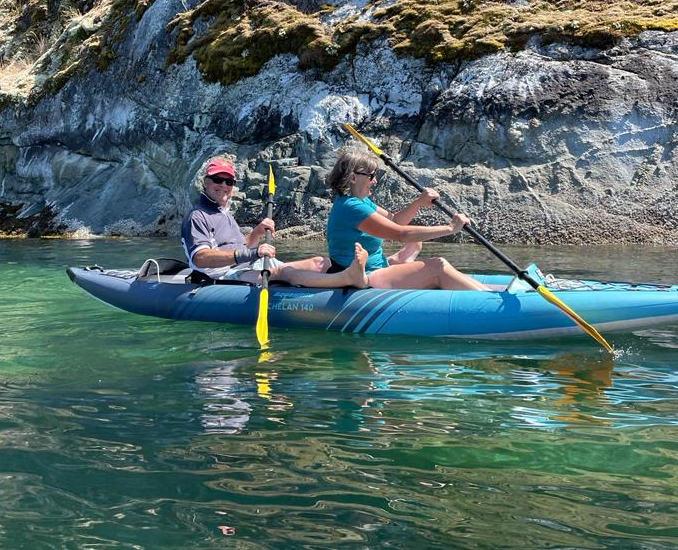
Thurston Bay was a delight after the torrential rain that we experienced in crowded Octopus Island. Like last year, the Octopus Islands are barren of crab and fish! Thurston Bay anchorage was idyllic, with kayak excursions, all day lunches washed down with chilled Sauvignon Blanc. Giggly girls in charge of a kayak didn’t deter the wildlife. We spied a river otter with her pup, loons sounding their haunting cry, busy kingfishers, American Minks and porpoises lazily swimming through the water. Far North witnessed a Black Bear munching on grass roots on the island but our view was obscured by one of the islets.
American Minks also known as Common Mink, Mink or Water Weasel and their Latin name Neovison vison. The two types of Mink here are inland and coastal, the latter being the Mink we saw periodically. They are semi aquatic animals, half the size of an average house cat and the Coastal Mink’s fur (pelage) is nut brown. Their habitat is mainly shorelines protected from heavy seas within inlets, bays, lagoons with abundance of crevices, rocks, boulders and thick plant life. The dens are above high tide line and they use natural cavities or man made structures below housing or in boats. They generally hunt for food in the intertidal zone at low water, generally in the daylight. Their favourite meals are fish, crabs, small birds and bird eggs. They are efficient hunters but they kill relentlessly, often catching surplus to their nutritional needs. Research has not got an answer for this, other than they maybe instinctively killing in case of periods of food deprivation. As their hunting ground is close to their dens, no trespassing from other minks and plenty of prey, Minks can exterminate their food source. They mark their territories with urine, faeces and musks, to ward off others. Throughout the seasons they remain active and their daily routine is influenced by the tides.
Adult Minks are solitary mammals except for the mating season in late May or a female caring for her offspring. Mating is an aggressive activity, often the females have nasty puncture wounds on the back of their necks. Gestation is 30 days with births in late June, the average litter being four. The babies are called Kits and they are sexually mature by the end of their first year. Life expectancy in the wild is between 3 and 5 years.
Their main predators are us for their pelts, road kill or attacking live stock ie chickens, ducks, eggs etc; Bobcat, Lynx, Coyote, Red Fox, Grey Wolf, River Otter, Eagles, Hawks and Owls.
After a few days we tore ourselves away from this wonderful anchorage and pottered up Nodales Channel, crossing the entrance of Philip’s Arm, which is renowned for icy blasts from the mountains at the head of the inlet. Gale warnings were issued in the nearby Johnstone Strait so we planned to anchor amongst the sheltered Cordero Islands, doing some fishing on the way. This passage was particularly beautiful with the backdrop of the mountains and the reflection of the trees in the water. We ended up anchoring a short distance from the busy Cordero Island anchorage tucked behind Erasmus Island. Far North and Amelie enjoyed the peace and quiet of an anchorage on our own, kayaking and paddle boarding. Underwater there was an abundance of life; huge sea cucumbers, rearing the top third of their bodies, with their bristly oral opening catching particles of food flying past, many different types of sea anemones, starfish of all shapes and sizes, massive Harbour seals checking us out and Kingfishers flitting around the bay. The anchor groaned over the rocky bottom but at least the chain was cleaned of remaining mud from the previous anchorage.
A beautiful, early morning start to get the best of the Greene Point Rapids and the favourable current in the notorious Johnstone Strait. The rapids were very swirly necessitating Stephen to hand steer. Debbie was on log and bear look out. The former, a few, the latter, nil. Our next base was in Billy Goat Bay on the northern side of Helmcken Island. Kayaking around here, we had to be on hyper alert to the raging current. The clarity of the water was amazing, looking down into the depths, watching the eerie fingers of kelp wafting in the current tethered on a rock below. Further towards the shoreline, meadows of healthy Eel grass with the tantalising possibility of yet more Dungeness crabs. Alas our trap was empty except for kelp on lifting. Great Blue Herons with their laryngitic cry were doing their stone statue impression, waiting for an innocent fish to swim by. Within a split second, the heron had caught his snack and gulped it down. Fishing resumed after the beak was cleaned, back to the waiting game.
We had our last supper with our trusty salty sea dog friends, Dave and Sheila, sleeping through their departure early the following morning and pottered around doing boat chores and batch cooking. A slight feeling of emptiness settled on Amelie as we had so enjoyed Dave and Sheila’s company and the laughter dwindled. This is a common feeling saying “ta, ta” to good friends but we soldiered on and pottered back across the Johnstone Strait to Tuna Point, late in the afternoon.
Stephen explained that we had anchored in this spot in 2016 but when we arrived, Debbie didn’t recognise it despite being exquisitely beautiful. Kelp suggested that the ground was rocky and shallow in areas. The shoreline was picture postcard, lined with trees and at their base, huge boulders. At low tide, tiny islets were attached to the land by fallen tree bridges. One rocky mound was topped with an azure painted cabin with a picture window. Fishing paraphernalia dusted the foreshore with a partially sunken fishing boat at the base of the cabin’s foundation. Dereliction and abandonment added to the romantic aura of this magical cove. Early evening a ghostly mist wafted across the water, causing a milky appearance. This phenomenon appeared to be a reflection of what was happening beneath the surface…..an explosion of fish eggs we believe or icy stream water mixing with seawater.
A ‘phone call alerted us to El Mundo thundering up the Johnstone Strait to join us for a spell. The El Mundos ventured into the cove under leaden skies, bouncy seas, visibility poor…..brave people!
The following morning brought blue skies and more sun. Debbie was entertained by two Bald Eagles on the low tide line, one in particular looking very awkward as he strutted over the rocks, fanning out his wings to keep balance with his head bowed. He resembled a little old man watching his step. Oyster Catchers were pecking at the weed, completely oblivious of the Eagle. Kingfishers once again were busy fishing, flitting past us as we kayaked around the islets. We read that the nearby Fanny Island nowadays housed the weather station for this part of the Johnstone Strait. Helmcken Island used to be the weather station up until several years ago but the wind recordings there (allegedly) were inaccurate by up to 20kts.
Far North rejoined us before heading slowly south and we were very happy to see them.
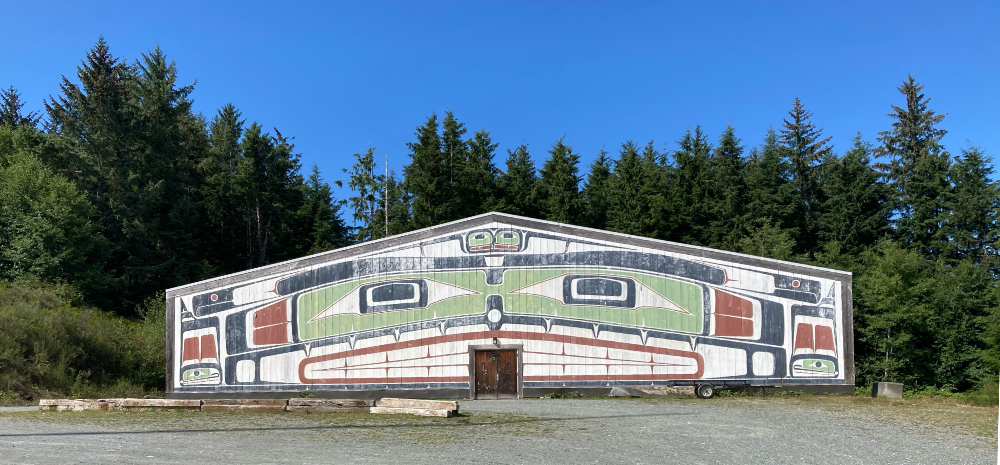
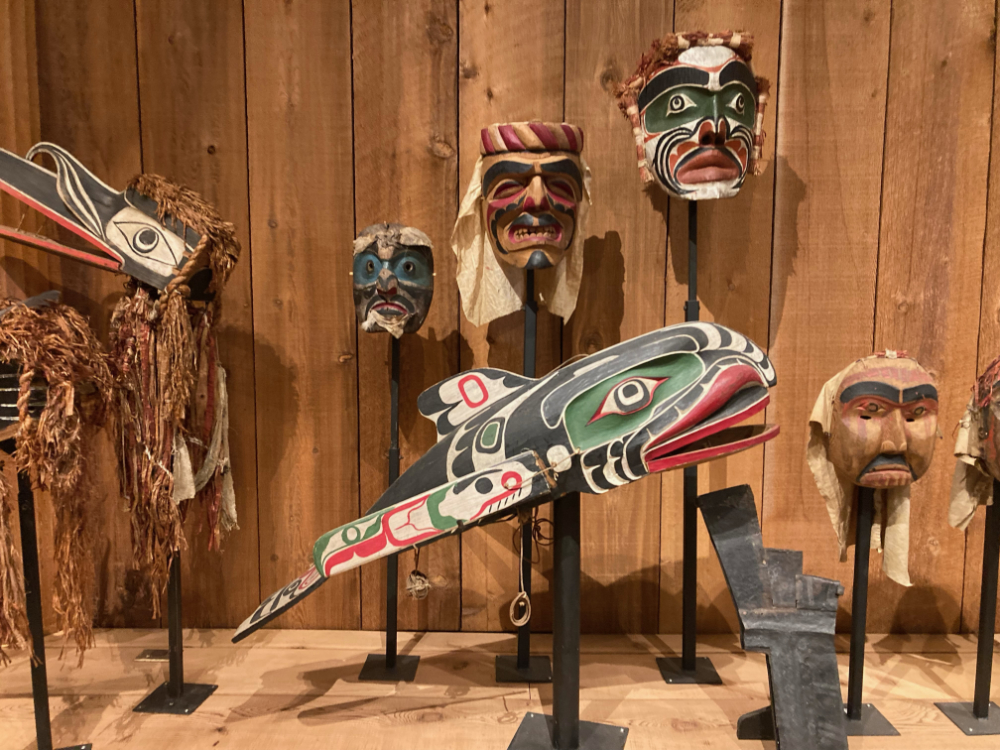
El Mundo and Amelie left sleeping Far North and continued our adventures north, catching a favourable current and minimal wind to Alert Bay, 37nm away. As we approached aband of fog hovered across the strait, making visibility tricky and naturally there were logs and kelp everywhere. After anchoring, we aided the island’s economy with a huge shopping trip and then ventured across the island to visit the tallest memorial pole and “Big House”. The building is used for Potlatches, traditional dancing and ceremonies. Outside is a huge playing field, primarily for the children but on Fathers’ Day in June, the community get together for a celebratory sports day. Alert Bay, as written about in our 2022 summer blog, is a strong First Nation community, a well organised and busy village. The people gave us a huge welcome, allowing us to dispose of rubbish free and generally passing the time of day. We witnessed this throughout the generations here. The guy at the supermarket checkout was chatty and happy, the marina manager could not do enough for us and the children in the sandpit were friendly and encouraging to Hana. While we waited for Hana to make new friends, a youngster adorned his head and arms with woven leaves. His tiny friend, with a stick, drummed on a massive log, chanting, while the older one traditionally danced around the play area. A beautiful experience, without either of them being self conscious and just doing what came naturally to them.
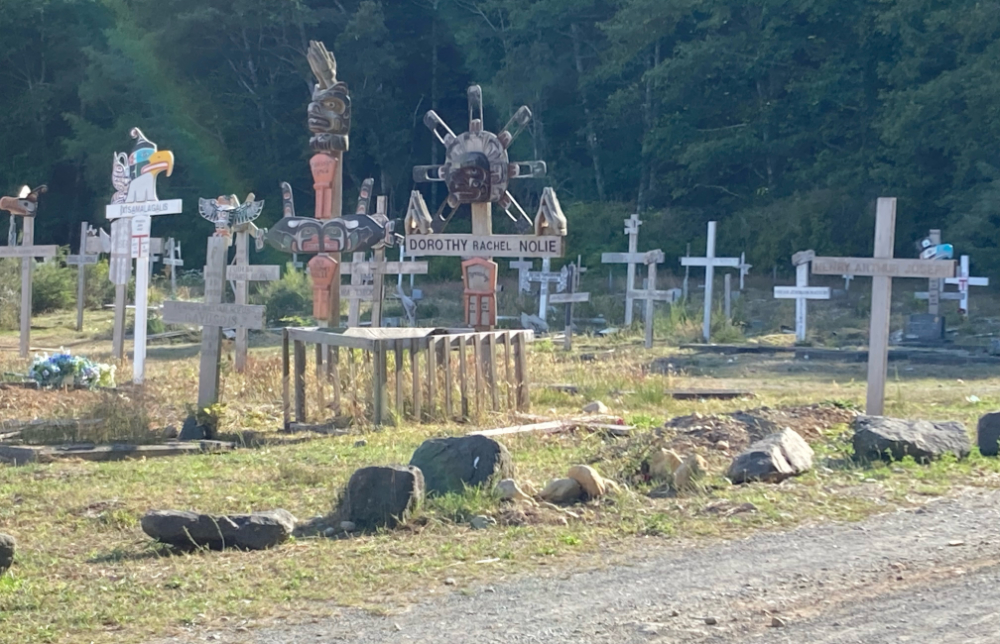
Our walk continued through a gnarled old forest, following a deer run from Leonard Point back to the Bighouse area. Here we came across a huge Indian cemetery, with crosses and traditional carvings at every grave. The community prefer for visitors to refrain from mooching around the graves as it is sacred ground.
The island despite being called Cormorant Island is filled with ravens, crows and bald eagles. The latter perching on the marina crane to get a better fishing position.
We decided to stay an extra day, visiting the museum and the ecological park. The museum was magnificent and with more time to wander around the exhibits, a positive story of life and community unfolded.
The Ecological Gardens originally (1880s) was a dam fed by underground fresh water springs to store water for a fish cannery down by the harbour until 1941. The area was left as a marshy area and present day has marked trails and boardwalks. The area looks like something out of “Planet of the Apes” or “Lord of the Rings”. Beauty and eerie charm, all rolled into one. The steep road climb to get to the park got us puffing and to start with we entered the nearby campground. A lone female asked us for help and the four adults helped erect her tent and gazebo for her camp table.
Leaving Alert Bay behind us we motored around Donegal Head on nearby Malcolm Island to fish. We saw several Humpback whales, plenty of large salmon jumping, however not a bite. We were rewarded with a two hour sail into Wells Passage in the Broughton Archipelago, spending the first night in Tracey Arm.
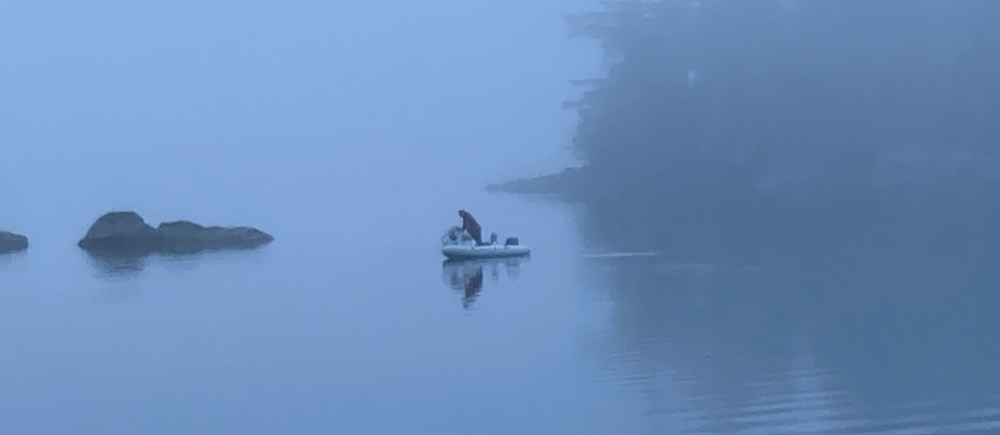
The Muirhead Islands were so beautiful last year and we decided to go back, through the challenging Stuart Narrows, being pirouetted in the whirlpools, looking out for bearactivity on the foreshore. We were rewarded later that afternoon when we took “M” for a long trek up the Actaeon Sound, passing old Japanese and Chinese logging camps from the last century, present day logging activity and a sighting of a healthy Black Bear, scratching at the barnacles and turning the rocks over looking for clams. Crabbing here was successful and we soon had the crab pot boiling, with a mixture of Dungeness and Red Rock crabs. A visit from a chubby singing Wren made our day, serenading us on the boom, unfazed by our presence.
The horrendous wildfires in Canada deemed cessation of logging, therefore this summer, Turnbull Cove was silent. We were rained in for a day in perfect Bear country, tidying up the boat and relaxing with books and films. El Mundo had left us on their journey south, as Hana needed a beach, they had flights to catch home and a boat to winterise.