

The first hint of autumn was the change in colour of the trees surrounding the city, harbour and hills. Horse chestnuts were littering the paths and brought back childhood memories of playing conkers.
The days were getting shorter and although we had warm, sunny September days there was a chill in the evening air. Halloween and Thanksgiving food and decorations adorned the shops.
The Vancouver skyline, compared to other cities of the world, does not have the “wow” factor and one morning, it dawned on Stephen that although the city has many trees, flowers and shrub gardens the skyscrapers or high-rise buildings are all grey, with the smaller apartments, a dirty brown. In the evenings the skies and cloud formations enhance the skyline but by day, our view from False Creek was dull. Vancouver has many attributes but alas not looks for us.
We were fortunate to be in Vancouver when Debbie’s friend and Jon’s Godfather, Andrew, was in the city on business. We took him on board and had a chilled evening catching up on the news over the five years since we’d seen him last. Plans were made to visit him and Ulli in February when we visit the UK. Our neighbours, Ginger and Peter, on their stunning classic Schooner, Irene, were great company and we spent a couple of evenings with them. Peter shamed us in his rowing abilities, making it look a breeze while we whizzed around in our engine propelled rib. Christmas 2015 we had met a kind, friendly guy in Bocas del Toro, John and his first mate Couscous (a cat), he introduced us by email to his friends who were living in False Creek. We delayed our departure and entertained Pam and Tim on board. We hit it off immediately and hope to see more of them over the winter.
A cinema date was organised and Stephen relished his box of popcorn (as in the good old days) whilst enjoying the film. We couldn’t leave Vancouver without a last visit to Granville market and spent a fortune on fresh produce and treats to enjoy over the next month.
Vancouver Island with her Gulf Islands beckoned us and we had our first decent sail across the strait of Georgia (Salish Sea) since we’d arrived in Canada. Conditions were perfect with a flat sea, sun, blue skies and a constant 9-10 knot wind on the beam. We arrived in Clam Bay (adjacent to Penelakut Island, a native reserve) for an overnighter in time for Happy Hour and made plans to catch up with Bubbles the following day to say goodbye to Karin and Hans who were leaving the following week. We had a brilliant evening enjoying a wonderful meal at the Sea Glass restaurant in Van Isle Marina. The desserts were a disappointment with too many strong flavours crammed into delicate classics but the port back on Bubbles finished off a great evening.
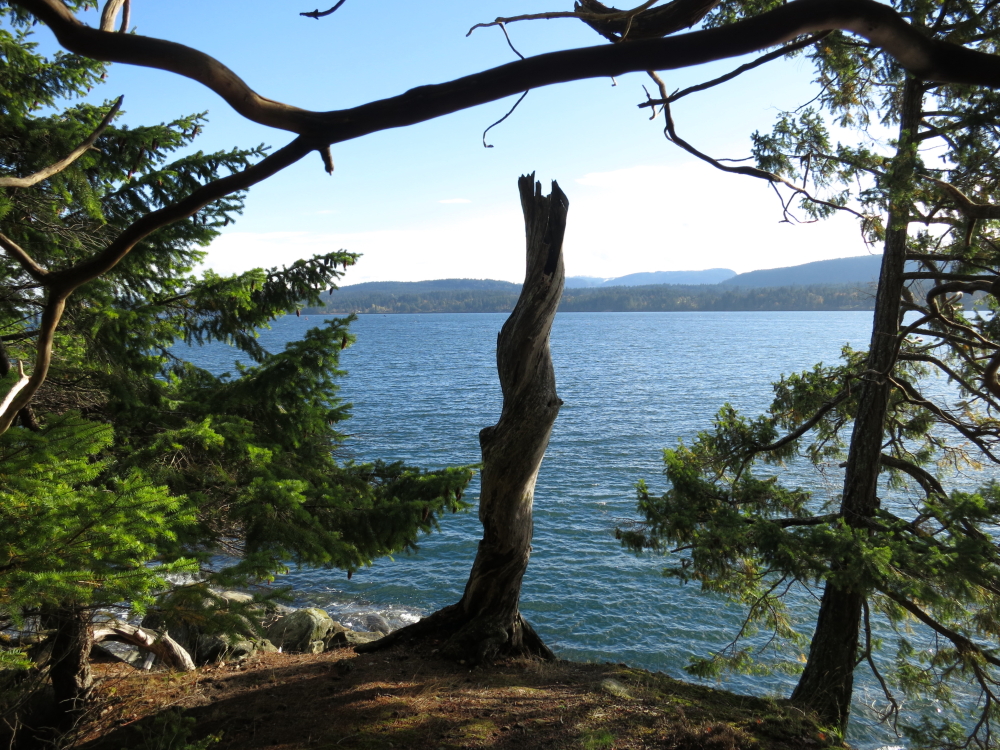
The month of October looked to be an exciting one for us exploring these beautiful islands before eventually mooring in Victoria for the winter.
The Gulf Islands lie along Vancouver Island’s southeast coast, protected from the west coast wind and very close to the Canadian/US border. The Gulf Islands are largely made of sandstone that has been folded and uplifted over millions of years, poking out of the sea. The islands are in the lee of the island and receive little rainfall during the summer months. Water is in short supply, unlike the ‘mainland’ of Vancouver Island. The climate in the islands is warm and dry, sometimes referred to as Canada’s Hawaii. The larger islands have large settlements with the ferries acting as the link between the mainland British Columbia and Vancouver Island. Many of the islands, are protected marine parks and ecological reserves, under the protection of the Gulf Islands National Park Reserve since 2004. The bird and marine life is prolific in the islands. We saw several pods of Orca and many different types of seabird, including the Great Blue Heron.
Our first anchorage was Montague Harbour, on Galiano Island. There is evidence of settlements here as far back as 1,000 BC. The sea and temperate rainforest provided the Coast Salish people with an abundance of food and shelter from storms. In 1792, a Spaniard, Captain Galiano, visited this area and surveyed the first sea charts of the Gulf Islands. He was honoured by naming this beautiful island after him. In the 1890s Japanese settlers came to the area and various charcoal pits have been found with one being restored in 2002 on Galiano. Today the north of the island is owned by the Penelakut First Nations. There are no predatory animals on Galiano so the many walking trails are safe to walk. We decided to take a 10 km road hike including stopping at the Hummingbird Pub which does exceptional pub food. Along the verges were many wildflowers with hairy caterpillars crossing our path. We had arrived on the last day of the peak season so various places were shut or closing down. The pace of life here is very chilled with a little activity around the harbour. Like ourselves there were numerous live-a-boards on their boats who were anchored or on one of the many buoys. We continued our hiking the following day using the Grey Point Trail in Montague Harbour Marine Provincial Park.
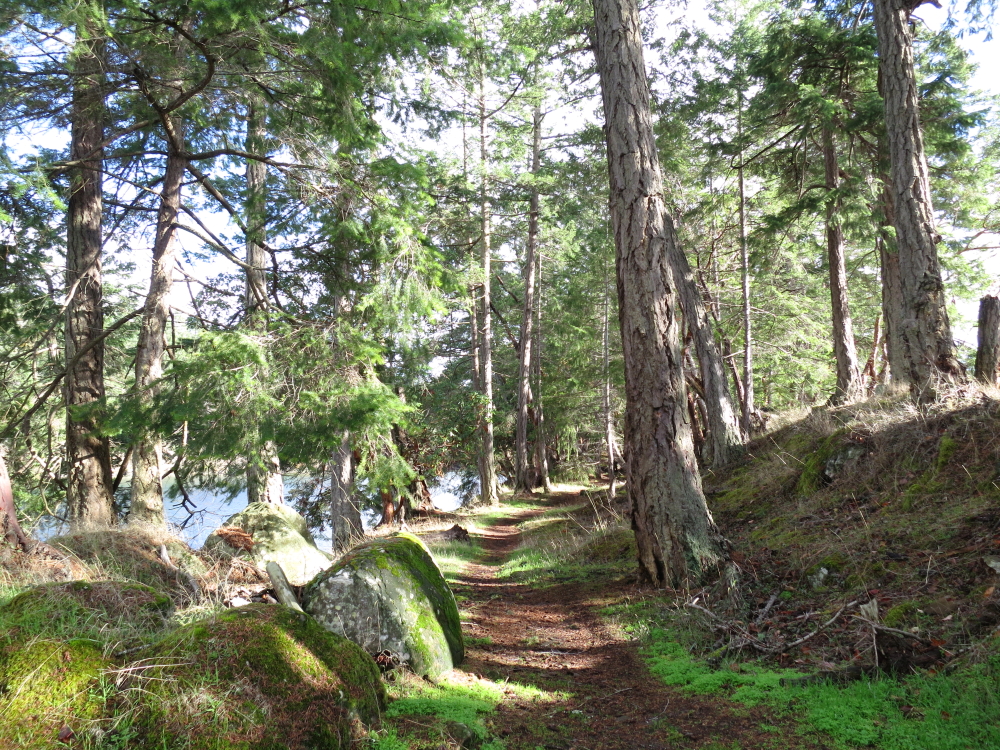
After passing through an impressive campsite we followed the trail down to the inlet and crossed over to a small island overlooking the Trincomali Channel. The forest path was littered with tiny pine cones, with towering Douglas firs and Cedars looming above us. Glimpses into the forest glades from the dappled sunlight added a mystic air to this place. Many of the trees were stripped of their bark displaying a rich red colour underneath……. the famous Arbutus trees, which need to be close to seawater to survive. The trail led us down to the stony, shelled beaches which appear white from the sea and we sat for a while on a fallen tree trunk watching a couple of yachts in the pass. Various bird calls were heard aloft and rounding a bend on the trail we came across a driftwood sculpture of a deer nestled under a tree. The odd dog walker and beachcomber were met but we mostly had the trail to ourselves. We took the rib for a spin around the harbour being nosey and looking at the various properties dotted along the coastline, many with private docks, and that finished off our days exploration. At night the solar lights sparkled along the paths up to the various dwellings resembling a fairy grotto. We were entertained several times a day by a seaplane flying in and out of the cluttered harbour, very close to Amelie.
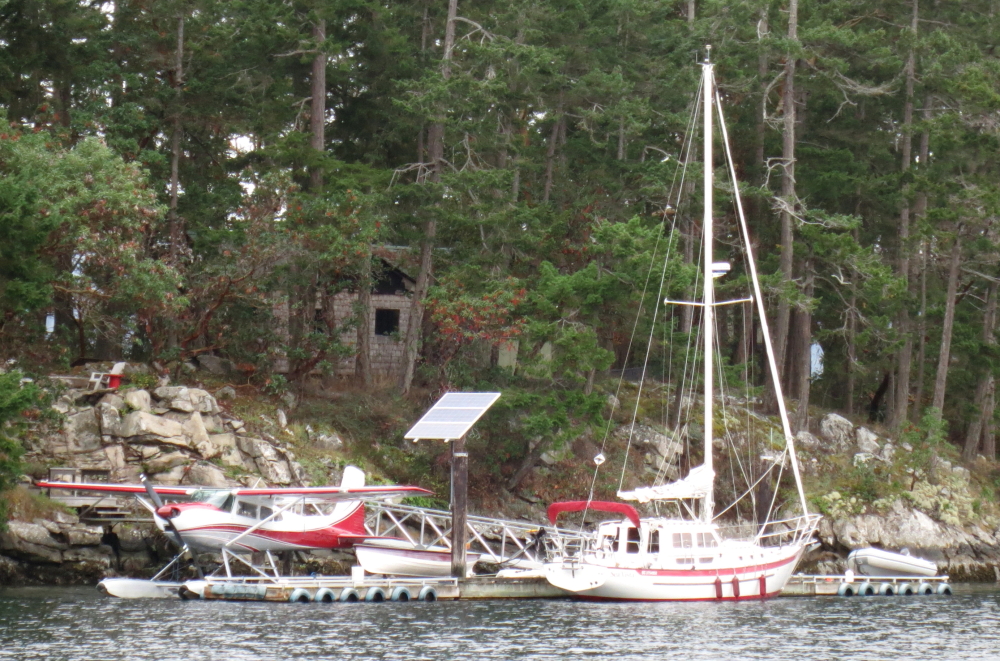
Our next port of call was Glenthorne Passage, a protected anchorage, off Prevost Island and between Owl and Secret Island which is littered with shoreside dwellings and their private docks (one of which had his yacht and seaplane moored up). A Harbour Seal greeted us as we anchored in the muddy bottom, alone in this sunny spot. We were surrounded by vacant private mooring buoys which obviously get busy in the summer months. Later in the afternoon we saw Mountain Goats grazing on the grassy banks close by. The only sounds were coming from bird calls and the haunting tone of the ferry horns alerting other vessels of their passage through near by Active Pass. The first gale of the season came through whilst we were anchored in this tranquil spot. We put out more anchor chain and hunkered down in the warmth of the cabin. As dark descended we were hailed by a brightly lit boat heading straight for us, asking after our welfare in the storm force winds. Leo also called us to see that we were okay and our OCC friends, Ian and Susan, suggested that we were in one of the most protected anchorages in the Gulf Islands. The kindness of people never fails to astound us.
We slept soundly that night and opened our eyes to a beautiful calm, sunny morning. We ventured off to Ganges on Salt Spring Island, cheerfully waving to the guy who checked up on us the night before. Salt Spring Island is the largest of the southern Gulf Islands, explored by the Spanish and the English in the 1700s and then settled by them in the 1850s. Ganges is the business hub and local commercial centre of the Gulf Islands. Ganges, an unusual name for these parts, was explained by an informative Indonesian gentleman in the Tourist Office. Ganges was named after the British Naval flagship H.M.S Ganges, which was built from teak in Bombay, India in 1821. John Fulford was the captain of this ship during its time in the Pacific Squadron. The ship and its men surveyed the island from 1857-1860. It was later used as a training ship for naval officers to the Royal Navy in Portsmouth before being scrapped. Uncannily we heard from Trevor Marston ( a sailing friend from Antigua and Tuamotus) stating that it was fifty years since he was first commissioned on the HMS Ganges as a young naval officer. The prime reason for visiting Ganges was for the farmers and artisans market. The town and its folk resemble the town of Totnes in Devon. Apart from arts, crafts, fresh produce and baked goods, the market offered mystical treats, crystals, holistic, natural products and healing arts. There are 3,500 ‘healers’ on this island alone. The following week was to be a busy social one, starting with Sky Valley Jazz at a local pub and then Canadian Thanksgiving Day was spent in Bedwell Harbour, South Pender Island, with our OCC friends, Ian and Susan on their yacht. We overnighted there before moving off to Tsehum Harbour to meet Leo. Leo was about to fly back to Holland leaving Bubbles in Tseum Harbour since the berths for the winter in Victoria were not available until 1 November. Stephen needed a handover briefing since we were going to deliver Bubbles to Victoria for him. The three of us ate together each day and we introduced Leo to Ian and Susan. The weather report was looking dire with a huge storm coming in. Kindly Ian had made enquiries on our behalf to shelter out the storm in the Royal Victoria Yacht Club Marina, very sheltered and with many friendly faces checking on our welfare and comfort. We can’t say enough about the kindness that we have experienced here in Canada. The barograph started to fall on the Friday and by Saturday was at its lowest that we had ever seen. We were expecting gusts of up to 55 knots, so we tethered everything down, removing flags and anything else that could act as a flying weapon. Seattle, (only a days sail from us) had taken a beating the day before so we were cautious and prepared. We were fortunate as we only saw gusts up to 31 knots. Our stay here was enhanced by meeting Nancy and Gerry (Gus and Zsa Zsa, their dogs) our neighbours in the marina. We spent a couple of evenings with them, getting more local knowledge for cruising these waters. We also had the privilege to meet an interesting guy called Peter on Mazu II who is attempting to sail solo around the world starting from the West coast of Vancouver Island. We wished him luck with a stiff G&T, Amelie style and will look forward to following his progress.
This would be an opportune moment to comment about the marinas that we have come across. They are generally well kept, clean with most facilities that a boater would require. What does stand out is the common respect for dangers at sea. All marinas and nearly all the docks have flotation devices for children (free of charge) to wear whilst on the pontoons. This is a brilliant idea and we believe has helped to reduce the number of accidents and fatalities. Another feature that Debbie got into was book swaps at these facilities. Debbie is a voracious reader and over the months she has swapped many times and consequently reading authors that she had never heard of, including first nation narratives.
Wallace Island had been mentioned to us several times and we motored to the west of the island under darkened skies threatening rain the whole trip. Wallace Island lies between Galiano and Salt Spring Islands. Rocks and reefs are prevalent in this cruising area and one such reef acts as a breakwater to Princess Cove (where we intended to anchor for a few days) and Conover Cove (too shallow for us). During the summer months this area is busy with visiting boats and as the cove is narrow, chains and mooring rings are secured into the shoreline rocks so vessels can moor stern to the shore, dropping an anchor to hold them steady. We had the cove mostly to ourselves so we just anchored. The sun erupted in the early afternoon allowing us the chance to hike through an Arbutus, Douglas Fir and Cedar forest, following a trail that had been made by many feet. This was the Wallace Island Marine Park, purchased by the local boating community. Kingfishers and Great Blue Herons were shrieking above us, keeping our attention on them rather than their nesting sites. The odd majestic Bald Eagle soaring above our heads, stopping us in our tracks to view this magnificent bird. The shoreline was a mass of nature’s artwork formed by erosion caused by glaciers and salt weathering during the past 90 million years. The sandstone looks as if it has been sculpted with a honeycombed appearance. The two coves are separated by a narrow stretch of land strewn with driftwood and logs resembling tossed giant matchsticks.
Once again the weather deteriorated so we remained in the anchorage until it passed. One afternoon we were entertained by a family of five Northern American River Otters playing on the private dock, close to Amelie. Chasing, play fighting, hiding under the tarpaulin of the beached dinghy on the dock and then gracefully slithering into the cold water to do a spot of fishing. Tasty morsels were devoured alone under tree roots and rocks before regrouping and swimming off together. We had the pleasure to watch one individual fishing close to Amelie, a sleek, long body with a pointed tail and unlike the Sea Otter, these otters swim on their front. Their ability to haul out of the water and scamper quickly along the land is unlike the Sea Otter, who seldom haul out due to their flipper like hind limbs which slow them down on land. This particular River Otter had a voracious appetite and constantly dived beneath the surface coming up after a while with a wriggling fish clutched in its jaws.
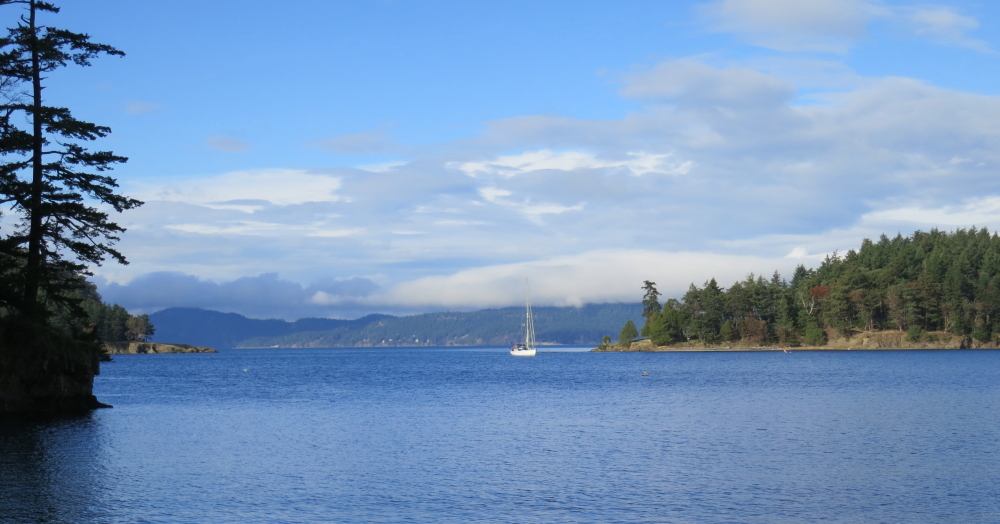
Stephen’s passport had been about to expire so Jaz had taken it back to the UK for posting to the passport office with an application for a new one. Dan and Verena had kindly taken possession of Stephen’s new passport, so we met up with them at Cherry Point and enjoyed entertaining them on board Amelie for the evening.
The following morning we left to cross to the American San Juan Islands. The islands are peaks of a sunken mountain range. Friday Harbour is the commercial hub of the San Juan Islands and Amelie’s port of entry to the USA. Once again, an uneventful, swift process and our yellow flag was lowered. The town is lovely with a mixture of old buildings and the newer ones, sympathetically resembling the older designs. Immediately you feel a sense of calm in this town with excellent provisioning opportunities, great boutiques and one of the best fishmongers that we have encountered, on the dock - Friday Harbour Seafood. Each day we took walks around the town discovering hidden gems in the streets off the main high street. We saw a film at the local, tiny cinema, buying our tickets out in the street. Stephen treated himself to freshly made popcorn which was dispensed from a machine that resembled something from a set from the “Game of Thrones”. A meal at the newly opened Blackfish Bistro was an unexpected gourmet experience using local produce. The whale museum taught us about the resident Orcas (J,K and L pods) that frequent these waters together with native folklore and traditional kayaks, baskets, weapons and art.
Sucia Island was our next stop, north of Friday Harbour, a marine park which is very popular in the summer. Sucia island is made of sandstone carved by seawater and the weather, producing artful shapes and designs. We anchored in Echo Bay in heavy, sticky clay. We kayaked ashore, beaching amongst sand and logs and took a forest walk over the island to Fossil Bay watching a flock of Canadian Geese deliberating whether to stay grazing or fly over us to the water. After much noisy honking a swim was decided on. The water was crystal clear, very tempting but icy cold. A Debbie moment occurred here with her mistaking geese for Emus - a comment that she will never live down.
In rain and murky visibility we motored to Prevost Harbour on Stuart Island, dodging huge ferries using the shipping lane. The architecture of the dwellings here was eclectic, it looked as if planning permission was not a priority. One area looked like a scene out of a horror movie and although the natural beauty was staggering, the overall feel was not comfortable. We decided to shake off this feeling as the weather had improved and we alighted on the land for another forest walk amongst a primitive campsite. Unfortunately Stephen got close and personal with a series of rocks under a slippery grassy slope, damaging his shoulder, hip and sustained a nasty gash on his elbow. Tough as he is, and stubborn too, he continued with the short walk and then retired to a hot shower back on Amelie, with Debbie patching him up. Lots of giggles that evening regarding our age and capabilities, nevertheless we can’t see ourselves slowing down our exploring, discovering new experiences or meeting interesting people.
One night was enough here and after a sound sleep we motored under a blue sky to Garrison Harbour on San Juan Island, around the corner from Roche Harbour. Travelling through a narrow pass and “rapids” we encountered stunning scenery together with lots of black windows (attractive summer holiday homes now empty for the winter). We were not far from English Bay where there are the old garrison buildings sitting forlornly looking out over the water. Deer graze on the pastureland and in the village centre of Roche Harbour, without no concern for the construction traffic and humans meandering around.
Roche Harbour is an idyllic area and on Halloween we became tourists, walking along the Yellow Brick Road (paved with yellow fire bricks which lined the kilns) in front of the Hotel de Haro, passing the old lime kilns, Chapel (doubled up as a school in the early years for the company children) and gardens. We continued up the hill towards the cottages and the old red school. The atmosphere was one of aged grandeur with the backdrop of the sea and forest. The quaint shops were decked out in cobwebs, spiders and a few Christmas decorations with the odd person kitted out for Halloween.
In 1787, Captain Lopez de Haro and his crew were the first Europeans to sail amongst these islands. By 1845 the Hudson’s Bay Company possessed the islands and built a log trading post at the head of Roche Harbour. British traders and American settlers were fighting over the rights to the islands and after the civil war Kaiser Wilhelm was asked to oversee the dispute and in 1872, he awarded the islands to the United States. In 1881 two brothers, the Scurrs, bought and built up a small lime industry in Roche harbour which was later incorporated into a larger lime company - The Tacoma and Roche Harbour Lime Company owned by the McMillin family. The lime was found to be the purest in the world. They built the Hotel de Haro in 1886 to provide accommodation for McMillin’s customers when they were negotiating the purchase of lime and a company town grew up around this hotel. The interior has never undergone major renovation. Apart from the lime works there was a barrel works, warehouse, docks, ships, piers, offices, store, church, school, barns and well maintained homes. The workers were paid in script, only used at the company store and this was still being used when the town was sold in 1956. Roche Harbour was sold to a Seattle businessman, Rueben.J.Tarte and he restored the area into a first class resort. In 1988, the town was sold again but continues to be a resort with modern facilities as well as maintaining an old world charm.
The days are getting much shorter now, the evenings much colder and Roche Harbour was a beautiful way to end our cruising in the fall and to enter the winter tucked up in Victoria on Vancouver Island.