The rainy season had set in and we waited for an ideal weather window to depart Moorea. We experienced a beautiful sail in calm seas, gentle, warm winds and a moonlit night, arriving the following morning to the green shores of Huahine and the news via Whatsapp of the safe arrival of our third grandchild, a boy, Fraser William.
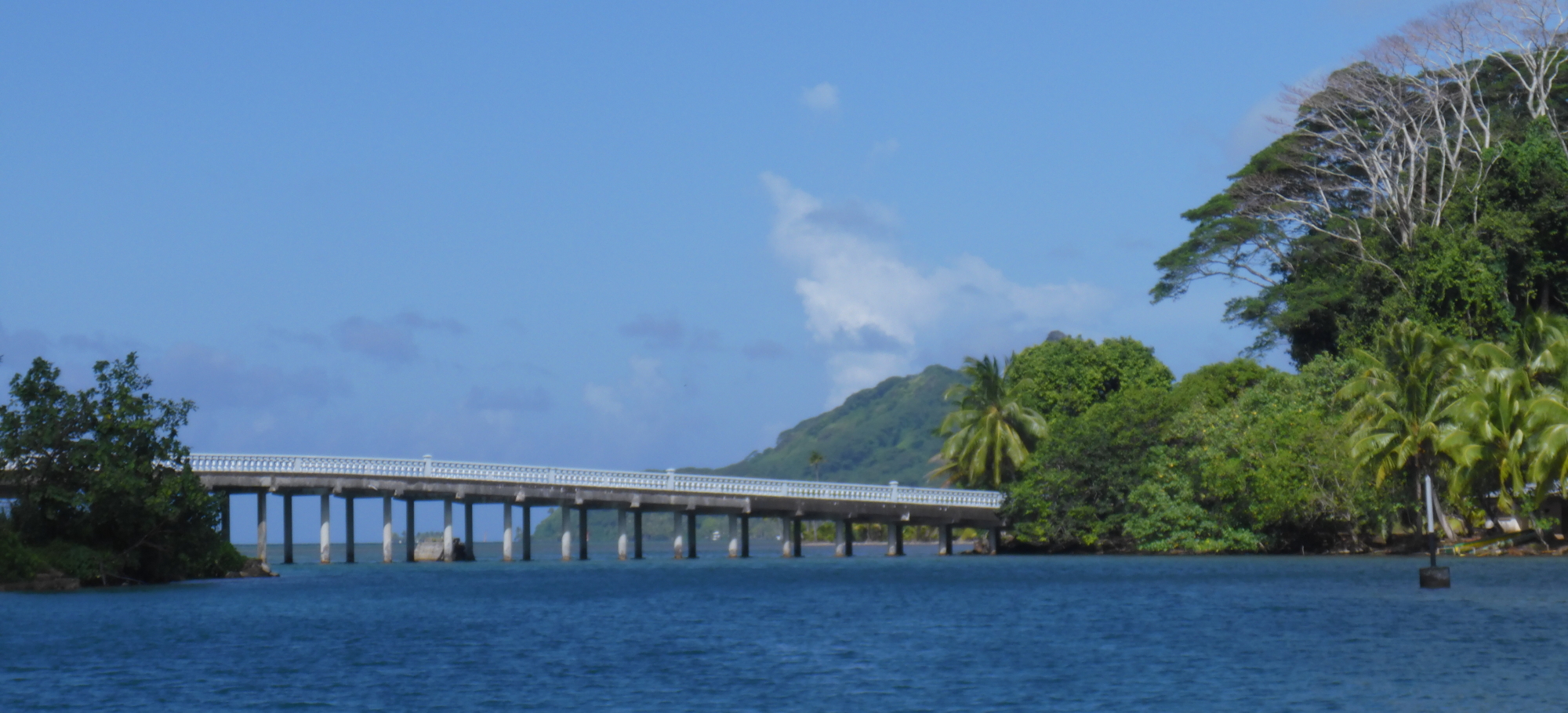
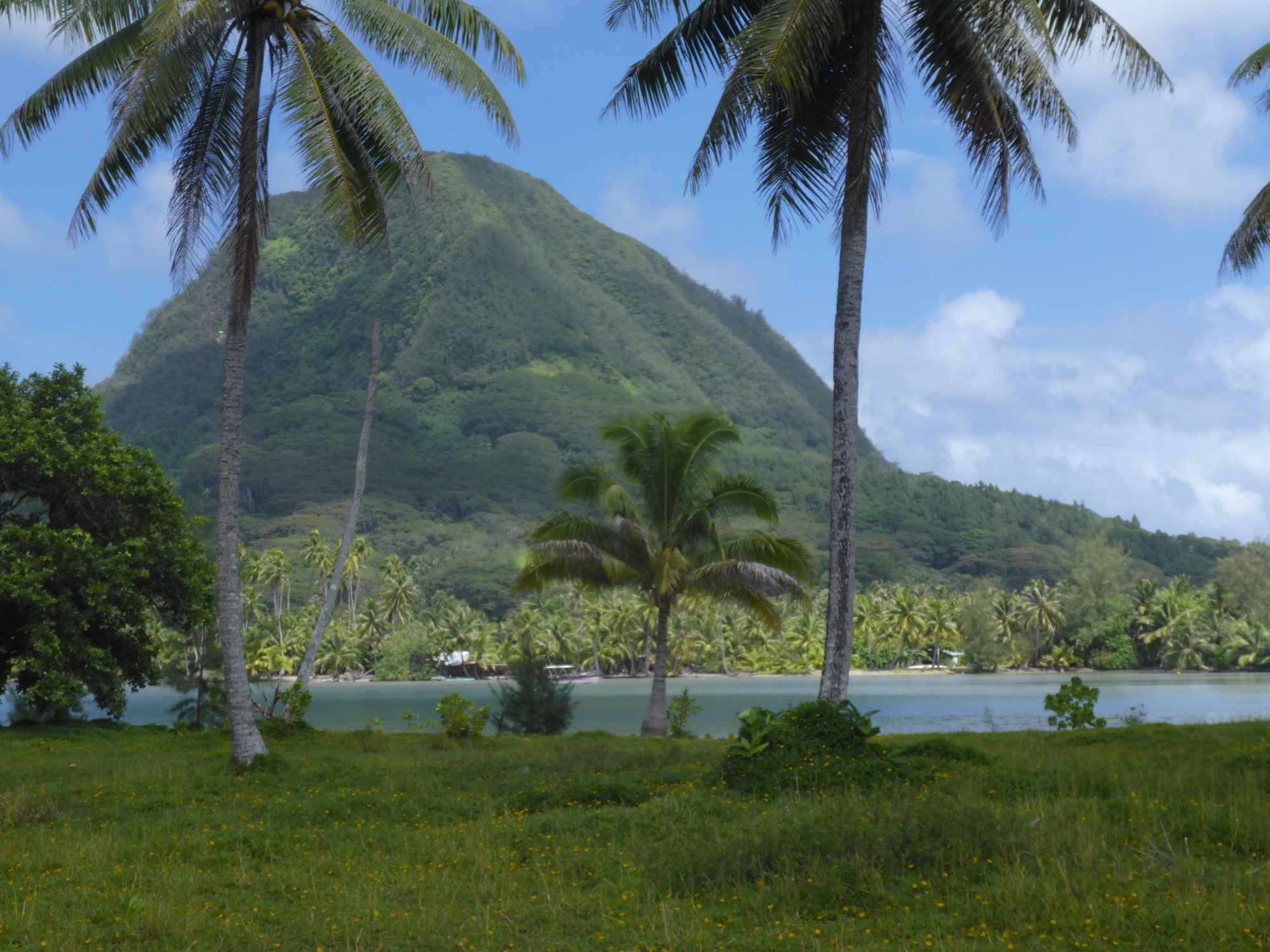
Huahine means “woman” and the geographical features of the island with Mount Turi projecting upwards resembles a reclining pregnant woman,a sign of the island’s irrefutable fertility. Huahine is also known as the “garden of Eden”. Originally, Huahine was called Matairea meaning “Happy Wind”. Three distinct volcanic eruptions caused the land mass to split into two which was then invaded by the sea, thus giving Huahine it’s characteristic shape. The northern mass is known as Huahine Nui and the southern mass as Huahine Iti. They are connected by a bridge in Maroe Bay. Mythology states that Hiro (God of thieves and sailors, is there a connection?) split the island in two and suggests there is the imprint of his fingers and paddle in Maroe Bay with a rocky area shaped like his phallus. The things Debbie unearths when she is doing her research!
Archeological findings to the north of the main town, Fare, suggest that the Lapita people were some of the earliest settlers in the Society Islands, about 700-850AD. This may have been a seasonally occupied camp for turtle hunting, using the camp to fish within the reef with stone traps, netting and access to the open seas for their canoes to offshore fishing grounds. Remains of reef and open sea fish have been found in this area, Green Turtle shells, coconut shells, fired stones, domestic artefacts, rat and bird bones, dated over a 1,000 years ago.
The Europeans arrived in Huahine in 1769 in the shape of Captain James Cook and his crew. He received a hostile reception but this did not deter him returning in 1774 and 1777. During his last stay he reported in his journal that a native of the island stole his sextant.
The people of Huahine continued to repel outsiders, supporting the royal family, against the French and were opposed to the later French colonisation, more so than their neighbours. The royal family had their family home in Tefarerii (House of Kings) on the east of Huahine Iti and their seat of royal power was in the small village of Maeva, NE of Huahine Nui. Huahine remained independent although heavily influenced by the English until 1888, after two violent interactions with the French in 1846 and then in 1888. The French during this fractious time called the island “La Sauvage”. Tahiti signed a protectorate treaty with France in 1847, meanwhile little Huahine held out. It was not until 1946 that the people of Huahine received full French citizenship.
Huahine’s population in 2017 was recorded as 6,400, living a traditional lifestyle, in a small-village type culture. They fish and grow crops for the family and sell the surplus. The economy is based on minimal tourism (few resorts), agriculture and their watermelon, rock-melons and vanilla crops.
We entered Huahine Nui via the Passe Avamoa, opposite the sleepy port of Fare, the main administrative and commercial centre of the island. We followed the channel markers, passing anchorages and glimpses of beautiful bays and Motus, until we reached the southern tip of Huahine Iti and anchored in sand in Avea Bay. An idyllic bay surrounded by a white, sandy beach and in places, fascinating coral areas and a beautiful underwater world. The dwellings on the shore are a mixture of large waterside homes and shacks, a restaurant and a hotel, which was closed during our time for renovations and the owners’ holiday.
Snorkelling off the Parea reef near Motu Araara and the dangerous Araara Pass was a delight. Quite a workout due to the density of the coral and trying to find a circular route back to the dinghy. Plenty of Tahitian Stingrays or are they now called Huahine Stingrays because of our location? Later we circumnavigated Huahine Iti in “M”, using the markers, eyeballing and traversing under the bridge that connects the land masses. The Motus are huge off the western side and many settlements are dotted along the waterside.
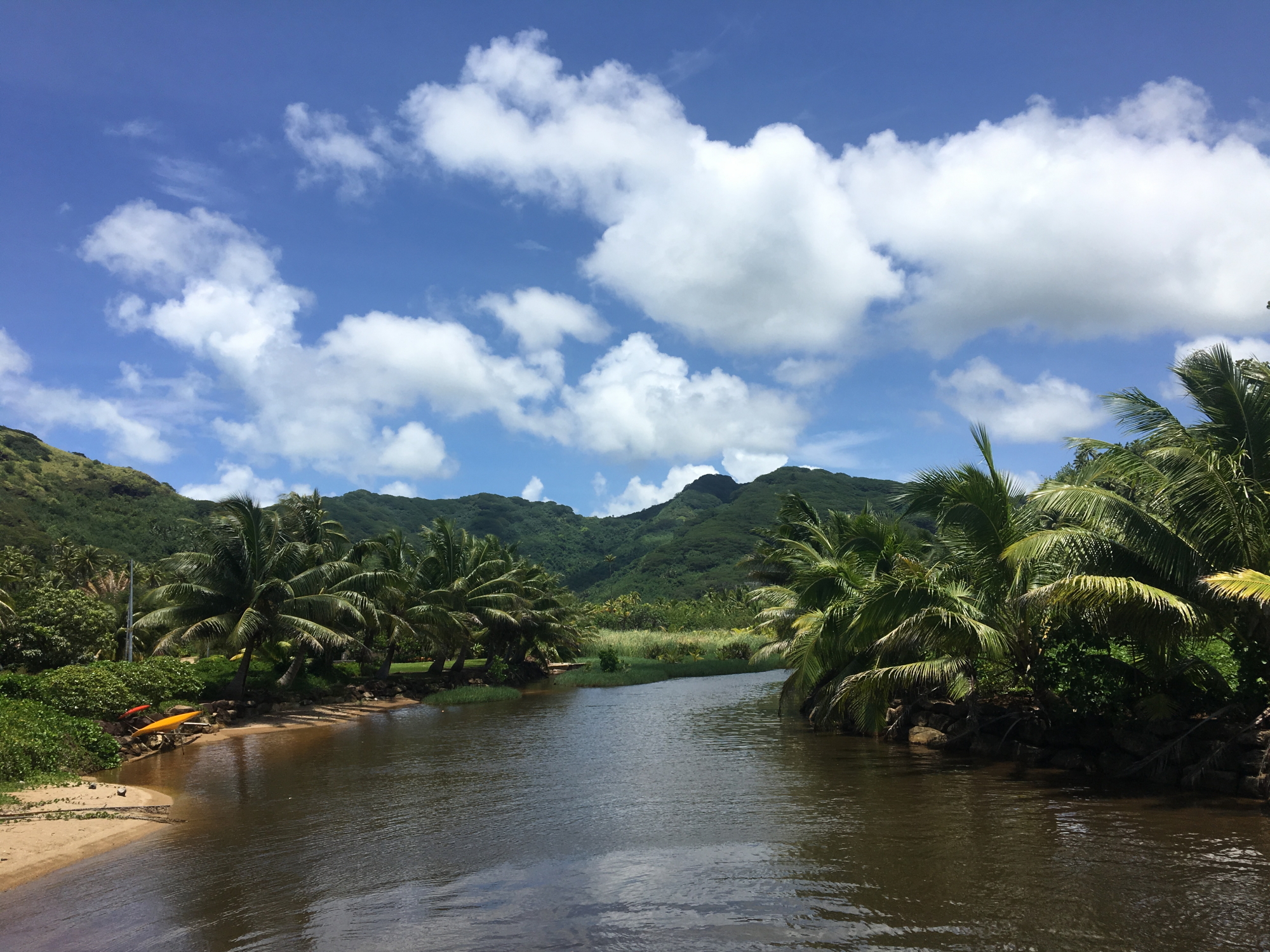
Another day we kayaked past the hotel and tied “Kitty Kayak” off to a tree and walked along the road to Marae Anini, dedicated to Hiro and Oro, God of War. This is a recently constructed community marae built on the site of an ancient one. The entrance to the site was adorned with coral hanging displays interspersed with beds of flowers. The blocks of black volcanic stone were unlike ones that we had seen and were being used for picnics and the gathering of local people, the purpose of the project. There are approximately 200 or more ancient temples (maraes) on the island, but only thirty that have been excavated.
Our other mode of transport is our two legs, which we use frequently, for practicalities like beer purchasing but also for pleasure and fitness. Several kilometres a few times a week is nothing unusual but now and again we do a biggy. Debbie was keen to see several villages on the SE and E side of Huahine Iti, so we kayaked to the beach and set off for the mammoth walk, skirting the coast and crossing a number of shallow inlets by the tarmac road system. The first village was Parea which is not mentioned in the guide books. A very pretty commune with beautiful outlooks across the lagoon. Here we found a young lady involved in her cottage industry of making, painting and selling Pareos (sarongs). Her small shaded garden was alight with colour from her materials and some that were completed were curing in the dappled sun. Delicate and exquisite pieces and certainly the most beautiful we’ve come across, unfortunately with a huge price tag to match. We assumed that each village would have a small magazin (shop) but this wasn’t the case. Apart from the store near to our anchorage there was a small kiosk further into our walk, selling basic items. We carried along the road, passing bulls and cows munching on the pasture, a digger in the shallows digging up sand and coral for building materials, many fishing boats and kayaks at the waters edge, ready to be launched and dogs, dogs, dogs. A couple of puppies took an unwelcome interest in Stephen’s ankles, they would have bitten him if he hadn’t have pushed them away. There are a few steep parts to the road which lead us to Panorama de Tefarerii - House of the Kings. The lagoon colours were mesmerising, shimmering in the sun, looking over towards Motu Murimahora. Descending towards the village, that over a hundred years ago was the home of the most powerful family in Huahine, was a huge disappointment. It was soulless, not particularly pretty and we couldn’t find anything connected with its past. Some of the properties were dominated by a huge burial plot in the front lawn, adorned with fake flowers and Li (garlands). We believe that one of the graves was a fisherman's as the hanging baskets were in the shape of canoes. Each plot was shaped like a small house sometimes blocking the view from the main house. We returned the way we came, a round trip of over 18 km with aching knees and feet, due to the pounding on the hot tarmac road but very satisfied that we had seen more of this beautiful island. The following day, a day of rest was ordered.
Coming back from one of our shoreside walks we spotted an Alaskan yacht in our anchorage. We buzzed by in “Kitty” and introduced ourselves in typical “Amelie” style. We ended up having a very impromptu drinks and supper on Amelie. They set off the next day for Kiribati, they enjoyed very remote anchorages. As a final gesture they gave Stephen their supply of pipe tobacco. Several weeks later we received an email from the “Respite” crew to say that they suffered a wind shift whilst anchored off Flint Island and the boat was wrecked on the reef. They were eventually rescued by the French Navy some three days later during which time they stripped the stricken vessel of everything of value, built a shelter and had a party whilst waiting to be rescued. What a team! It does remind us that this idyllic lifestyle does come with some risk!The squalls we encountered in this bay were violent and drenching, although the anchor held fast we decided to change anchorage and motored within the lagoon north west and ended up in a tight anchorage in Haamene Bay, opposite to Fare. The snorkelling and clarity of the water was better than Avea Bay with Bat Rays, Picasso Trigger fish, large Trevallies and an enormous Porcupine fish under Amelie, benefitting from our anchor chain movement for stirring up the food from the seabed. During our stay we were approached by a small fishing boat with a family selling live lobsters….Surf and Turf that particular evening, finding out later in our stay that it was not lobster season. Here we were boarded by the police checking our boat and personal papers, a couple of guys from Cherbourg who were very pleasant and chatty, doing their three year stint in FPI. We found a decent pontoon to tie our dinghy to, owned by Huahine Yacht Club, not the friendliest bar that we have experienced. A short walk along the main street brought us to the only supermarket on the island. The stock was vast within this huge store, certainly the Tahitian rum was the cheapest we had seen so far, $29 for two litres, (Ju would be in her element) it had to be added to ship’s stores at that price! Gin is cheaper than the Marquesas and Tuamotus and Debbie found some great bikinis. The sizing of clothes in the FPI is weird as most of the women are not slender but the cut of the clothes is on the tight side. Saying that the ladies have body confidence making a huge effort in their appearance, paying particular attention to their glossy hair adorned with fresh, floral crowns.
Fare is not an attractive town, quite utilitarian but the main port, with supply boats coming and going at odd hours of the day and night, weirdly at the weekends. It wasn’t helped that the main road was being dug up during our stay, creating sandy potholes full of water, dodging construction vehicles and the constant noise and clouds of dust that goes with these machines. The weather deteriorated whilst we were in the anchorage and on some days we couldn’t launch the dinghy and developed cabin fever. However upon walking around the small settlement with it’s hidden cafes, gift stores, bank, pharmacy, rental shops, hardware/electrical, fuel station and numerous fresh produce stands, we came across a member of Huahine royalty, Tua. Her English was exceptional and she was hovering over a huge, dusty tome, explaining to Debbie that she is related to the last King of Huahine and she has all the documents to prove it. She is in the process of filing her papers with the French government for them to acknowledge her status. Initially she intends to run for Mayor and then using her office, to regain her regal title. She is pro tourism and wishes to make it easier for the larger cruise liners to dock in Huahine. Her passion was palpable and maybe it was all in her head but Debbie could have spent hours listening to her stories. The many tourists in her shop hovered listening to her talk and consequently bought many of her trinkets.
During our time in Fare we received the sad news that Debbie’s aunt had passed. This obviously came as quite a shock but reflecting back on her influence on the young Debbie produced many smiles. A lady with a huge zest for life, who loved beautiful clothes and introduced Debbie to the finer and gourmet side of life from an early age, including Babycham!
Our Jersey ensign attracted the attention of a passing couple from one of the charter yachts. It turns out that Chris and Renee ran an oyster business in Jersey, we enjoyed a very convivial evening with them including Chris treating us to a fantastic meal at Huahine Yacht Club and three bottles of Cote de Provence…..naturally Debbie didn’t function the following day.
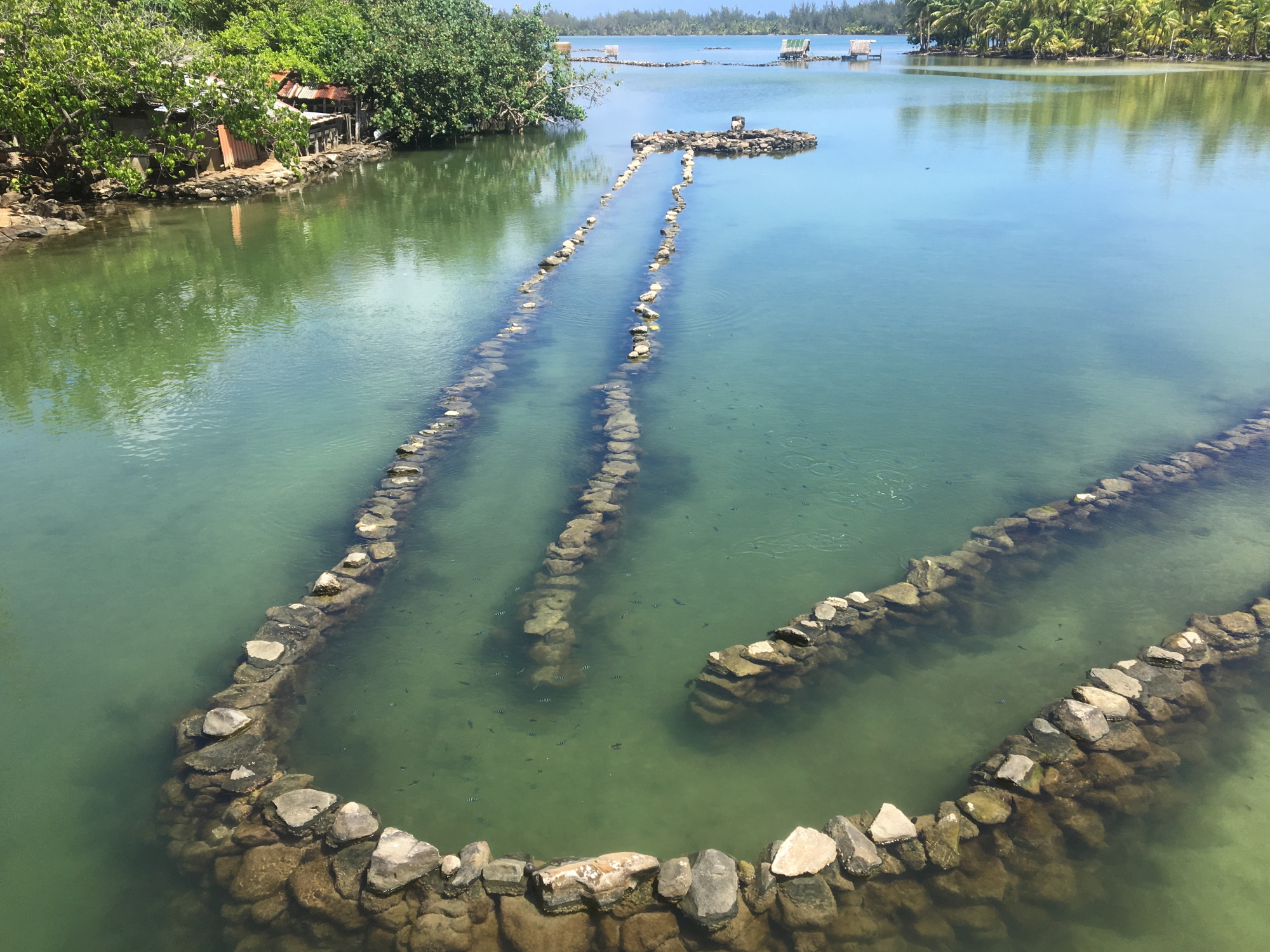
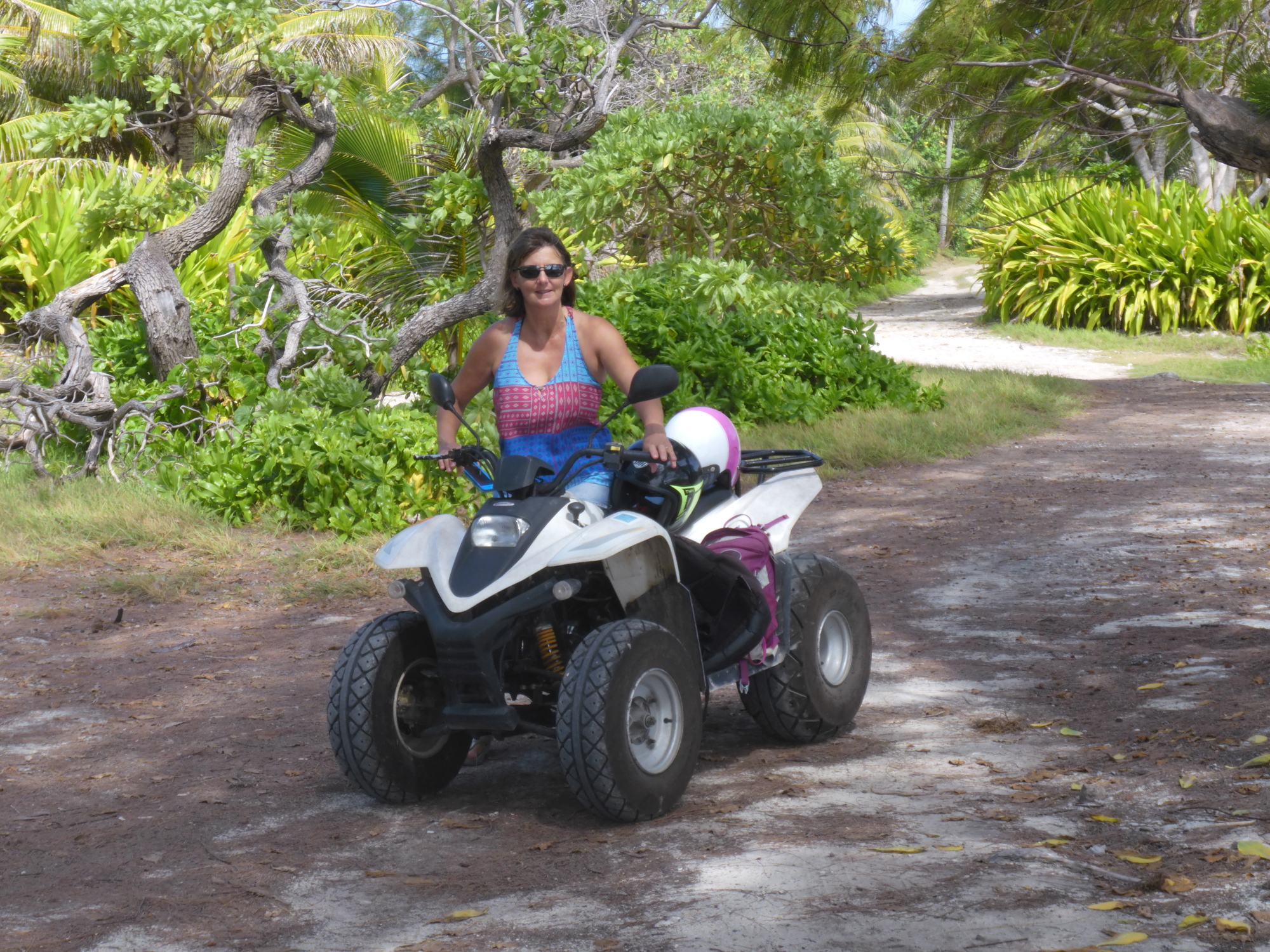
One of our final days in Huahine was spent on a Quad bike exploring the “Nui” part of Huahine. We travelled along various roads and dirt tracks, circling the massive lake with many waterside Maraes, passing under a tree canopied avenue, travelling through fishing villages, past vanilla plantations, over the mountain pass to the belvedere and our favourite site, was the ancient V-shaped stone fish traps in Lake Fauna Nui outside Maeva. These traps are still used today for capturing Mullet and Jackfish. They are considered sacred and only the descendants of the royal family can remove them. Close by the bridge were several graves commemorating those lost in the skirmishes with the French in the 1800s.
We went snorkelling in La Cite de Corail with its vicious current near the site of the former Sofitel resort. An overgrown area with the odd tiki poking its head above the knee high grass and two abandoned swimming pools infested with mosquitos. The place was eerie, desolate and crumbling, not a place to hang out at night.
Huahine is a place for slowing down and being at one with your environment. Fragrances spill over the water from the floral hedgerows, fires, rain on the trees and family cooking. One day tumbles into another without any effort and now it is time to move on to Huahine’s sister islands, Ra’iatea, Taha’a and Bora Bora.